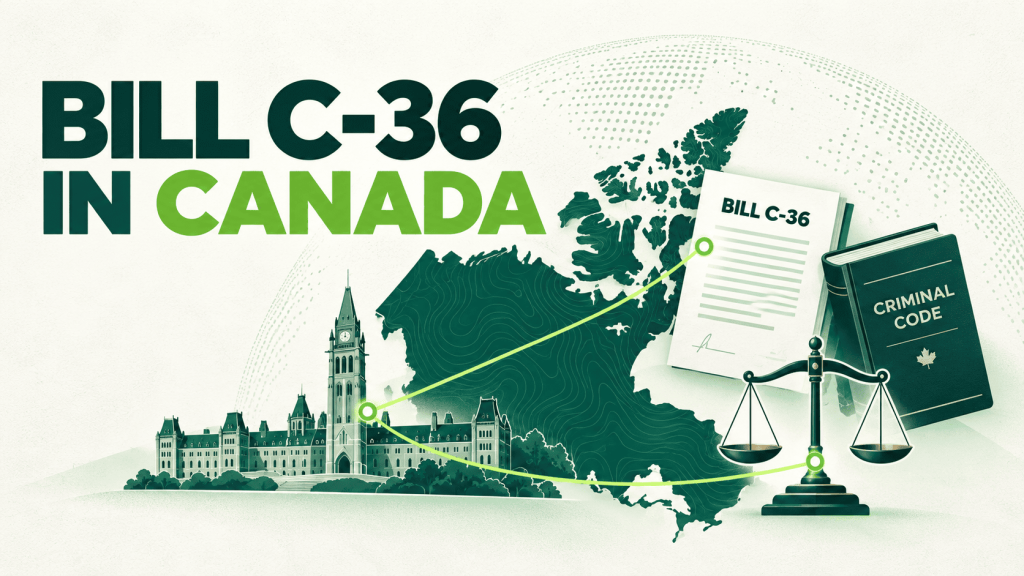
Bill C-36 changed Canada’s criminal laws on buying sexual services, advertising them, and benefiting from another person’s sex work. Passed in 2014 as the Protection of Communities and Exploited Persons Act (PCEPA), it remains the basis of several offences in the Criminal Code.
The short answer to “is Bill C-36 still in effect in Canada?” is yes, if you mean the 2014 sex-work legislation. Its main rules remain in the current Criminal Code. However, Canada has used the same bill number for different proposals, including a separate hate-speech bill introduced in 2021. Understanding the law means looking beyond its name. Buying, selling, advertising, and helping someone provide sexual services are treated differently. Court decisions also affect how particular provisions must be read.
This guide explains those differences, the law’s current status, and the main points of debate. It provides general legal information; individual cases require advice based on their facts.
Which Canadian Bill C-36 Does This Article Cover?
This article covers the 2014 Protection of Communities and Exploited Persons Act, introduced during the 41st Parliament, second session. References to “Canada Bill C-36” can also lead to a different proposal from 2021, so checking the year is essential.
| Bill | Main subject | Legislative outcome |
| Bill C-36, 2014: 41st Parliament, second session | Sexual services and related Criminal Code offences | Received Royal Assent and became law |
| Bill C-36, 2021: 43rd Parliament, second session | Hate propaganda, hate crimes, and hate speech | Did not become law in that session |
The 2014 parliamentary record confirms Royal Assent. The 2021 parliamentary record shows that the later proposal completed first reading but did not reach final passage.
The bill number alone cannot establish whether a law exists. The year, parliamentary session, and full title identify the legislation. A headline about the 2021 proposal therefore says nothing about whether the 2014 Act is still operating.
Is Bill C-36 Still In Effect In Canada?
Yes. The criminal-law framework introduced through the 2014 Bill C-36 remains in effect. The current Criminal Code still contains the purchasing, material-benefit, procuring, advertising, and immunity provisions associated with that legislation.
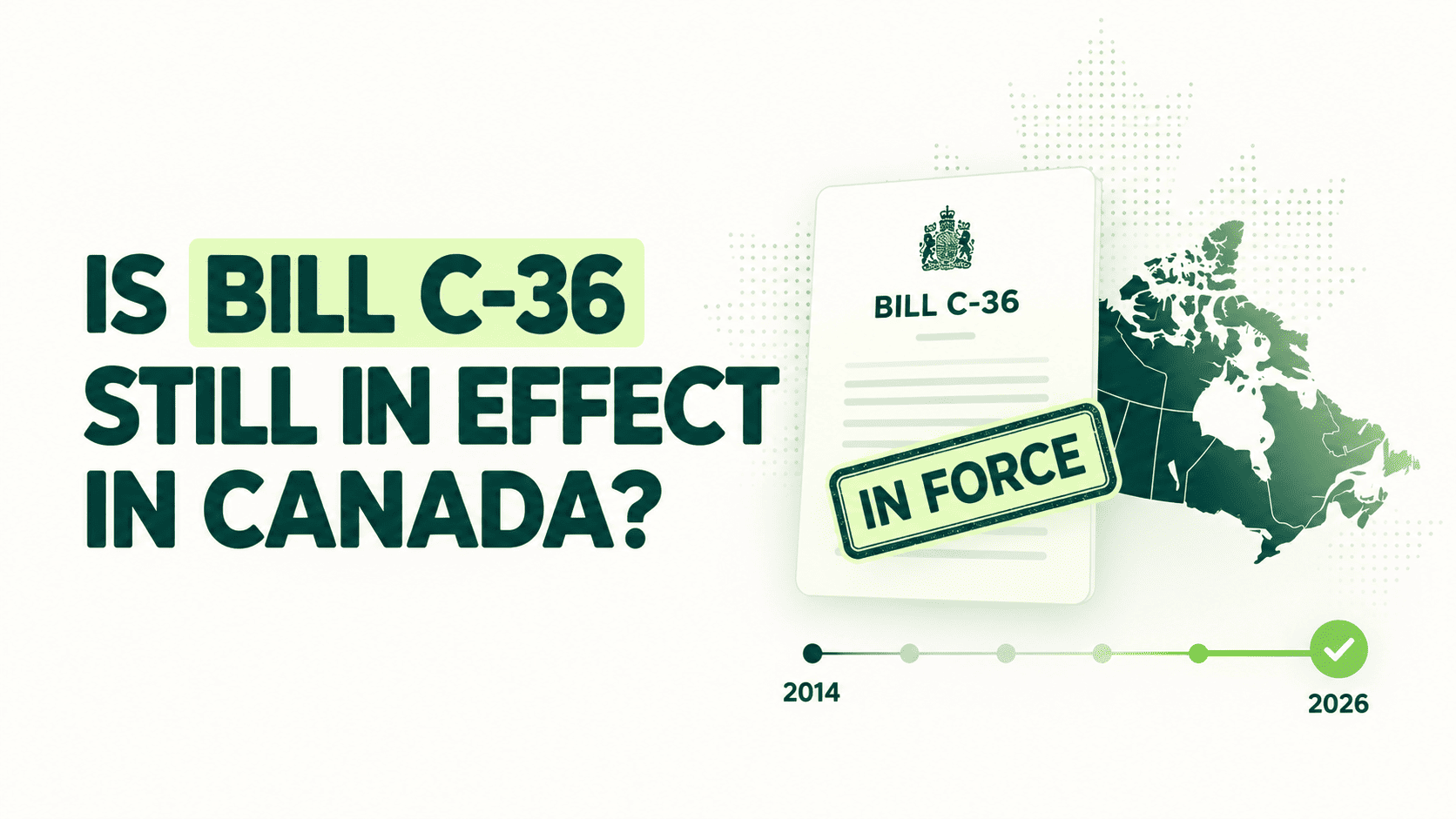
Strictly speaking, a bill is a proposal before Parliament. Once enacted, Bill C-36 became an Act that changed other legislation. People continue to use its bill number as a familiar name for those changes.
For today’s rules, the consolidated Criminal Code is more useful than the bill’s original text. A consolidated version brings later amendments together with the existing law. An old fact sheet may correctly describe the law when it passed while giving penalties that have since changed.
Court challenges have not repealed the whole framework. In July 2025, the Supreme Court of Canada upheld two challenged offences in R. v. Kloubakov. The scope of that ruling is explained below.
A proposal to repeal legislation, a committee recommendation, and a court judgment are different legal events. None should be treated as proof that every provision has stopped applying. A status check needs to identify the particular provision and the legal effect of any change.
Why Did Canada Introduce Bill C-36?
The immediate background was the Supreme Court’s 2013 decision in Canada (Attorney General) v. Bedford. The Court examined three older restrictions affecting prostitution:
- Keeping or being in a bawdy-house for prostitution.
- Living on the earnings of another person’s prostitution.
- Communicating in public for prostitution-related purposes.
The Court found that these rules violated section 7 of the Canadian Charter of Rights and Freedoms, which protects life, liberty, and security of the person. The restrictions exposed sex workers to danger by limiting safety measures, including working indoors, screening clients, and obtaining protective assistance.
The Court suspended its declaration of invalidity for one year. That gave Parliament time to respond. The decision left room for new legislation that complied with the Constitution.
According to the Library of Parliament’s legislative summary, the government introduced Bill C-36 on June 4, 2014. It received Royal Assent on November 6 and came into force on December 6 that year.
The government’s approach focused on reducing demand. Its stated goals included protecting people selling sexual services, protecting communities and children, and reducing prostitution. These were the legislation’s policy goals; whether it achieves them is a separate question.
This approach is often called the Nordic or end-demand model. It places criminal responsibility on purchasers and certain third parties while offering specific protections to sellers. Canada’s version also retains offences that can apply to sellers in particular public settings.
What Activities Does Bill C-36 Criminalize?
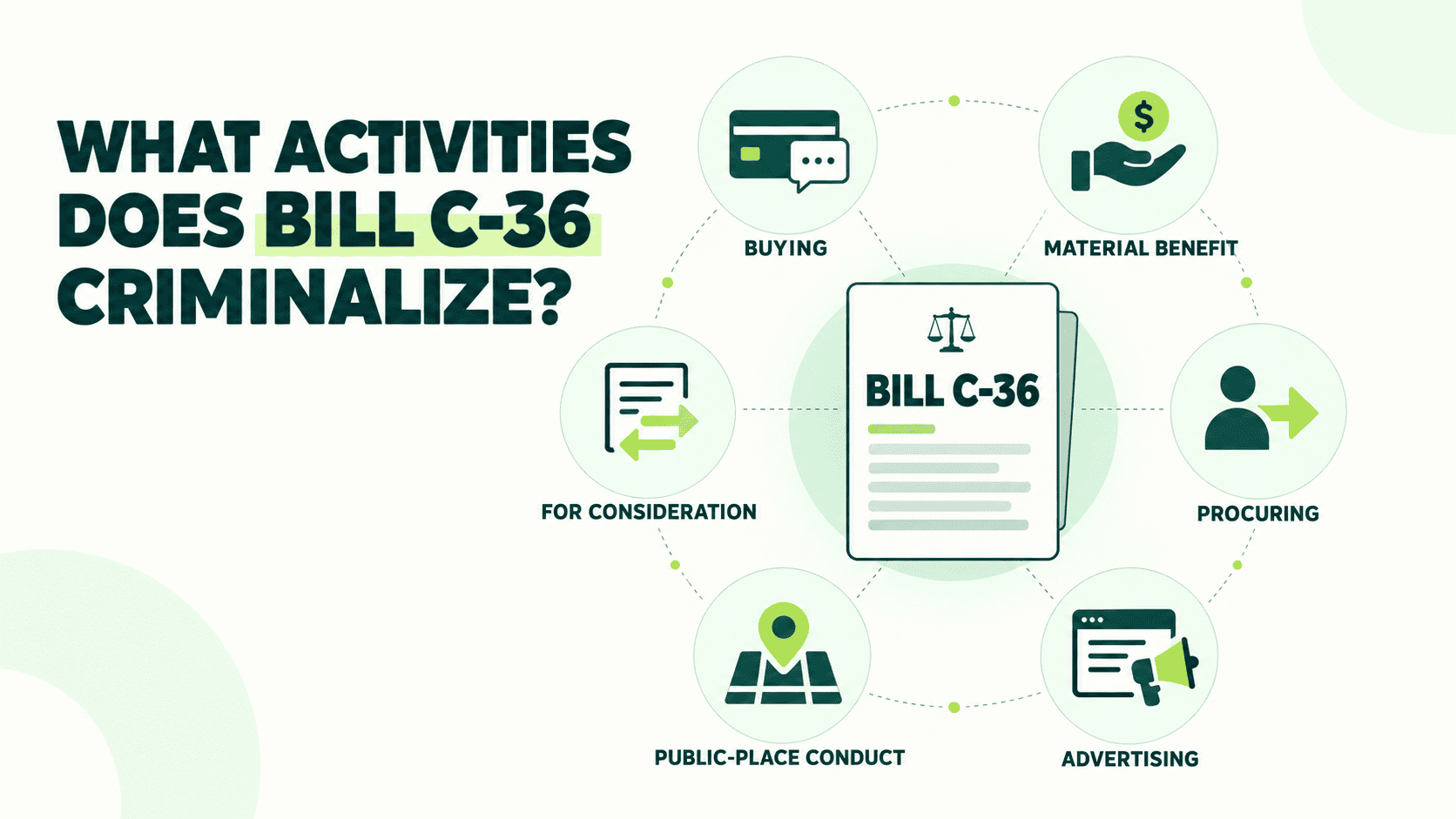
The framework contains several offences. Each has its own requirements, and some include exceptions or protections from prosecution. The following overview should be read alongside the current statutory text.
Buying Sexual Services Or Communicating To Buy Them
Under section 286.1, obtaining sexual services for payment or another agreed benefit is an offence. Communicating for that purpose is also covered. The purchase does not have to be completed for the communication offence to matter.
The prohibition applies in any place. A private setting does not create a general exemption. The section separately addresses services involving a person under 18, with more serious consequences.
For the adult purchasing offence, the current text permits prosecution by indictment or summary conviction. It includes a maximum prison term of five years on indictment and a schedule of minimum fines. The applicable fine depends on factors including previous convictions, location, and prosecution route.
As currently written, section 286.1(2) provides a maximum of 14 years for obtaining, or communicating to obtain, sexual services from someone under 18. Older guidance may list a different maximum, which is one reason to check the current provision.
“Summary conviction” and “indictment” refer to different prosecution procedures. Where a provision allows both, the chosen route affects the available sentence. A minimum fine is not a complete description of the consequences, and a maximum prison term is not an automatic sentence.
These are statutory sentencing rules, rather than a prediction of what a particular defendant will receive. Applicable judgments and the circumstances of the case also matter.
Receiving A Material Benefit From Someone Else’s Sexual Services
Section 286.2 addresses receiving money or another material benefit while knowing that it comes, directly or indirectly, from the purchasing offence.
The provision includes exceptions for legitimate living arrangements, legal or moral obligations, and qualifying goods or services. This means ordinary family support and legitimate services cannot simply be grouped together with prohibited conduct.
Those exceptions have limits. The statute identifies circumstances involving violence, abuse of trust or authority, intoxicants used to encourage providing services, procuring, and commercial enterprises offering sexual services.
A person’s role needs careful examination. Calling someone a driver, partner, landlord, or manager does not establish whether the offence applies. The financial arrangement, conduct, knowledge, statutory exceptions, and relevant court interpretation all matter.
Procuring Another Person To Provide Sexual Services
The procuring offence concerns active involvement in another person’s provision of sexual services. The enacted legislation sets out section 286.3, including procuring someone to offer or provide sexual services for consideration.
It also addresses specified conduct undertaken to facilitate a purchasing offence, such as recruiting, holding, concealing, harbouring, or controlling a person’s movements.
“Procuring” should therefore be explained carefully. A broad phrase such as “helping a sex worker” does not describe the legal test. The prosecution must establish the elements of the offence, including the required purpose or intent for the conduct alleged.
The distinction matters when discussing safety advice, accommodation, transport, or administrative help. Those activities require analysis under the law; their everyday labels cannot replace that analysis.
Advertising Sexual Services
Section 286.4 prohibits knowingly advertising an offer to provide sexual services for consideration. Section 286.5 supplies protection from prosecution for advertising one’s own services.
Together, these provisions explain why advertising one’s own services and publishing advertisements for other people create different legal questions.
An advertisement’s format does not settle the issue. The relevant questions concern what is being offered, who is advertising it, and whether the required knowledge is present. A description of the law should keep those elements visible instead of treating all adult-related online content as one category.
Certain Conduct In Public Places
Section 213 is especially important because it can apply to people offering or providing their own services.
Subsection 213(1.1) prohibits communication for that purpose in a public place, or a place open to public view, that is or is next to a school ground, playground, or daycare centre.
Subsection 213(1) separately covers stopping or attempting to stop vehicles, obstructing pedestrian or vehicle traffic, or obstructing access to nearby premises for the specified purposes.
These restrictions make the statement “sellers can never be charged” inaccurate. The law gives sellers certain protections, but those protections do not remove every offence that could apply to their conduct.
What Does “For Consideration” Mean?
The word “consideration” describes the agreed exchange involved in the service. Payment is a common example, but the legal question is broader than whether cash changed hands.
Justice Canada’s technical explanation describes an agreement for a specific sexual service in return for consideration. The exchange must connect the benefit to the service. A gift within a relationship does not automatically establish such an agreement.
This distinction prevents ordinary relationship support from being treated as proof of a commercial sexual transaction without examining the evidence. It also shows why the parties’ descriptions alone may not answer the legal question.
What Protections Do People Selling Their Own Services Have?
Section 286.5 provides specific protections from prosecution. A person cannot be prosecuted under the material-benefit offence where the benefit comes from their own sexual services, or under the advertising offence for advertising their own services.
It also protects against specified forms of participation in offences under sections 286.1 to 286.4, including aiding, abetting, and conspiracy, when the offence relates to offering or providing that person’s own services.
The phrase “their own services” is central. The protection does not automatically cover conduct involving someone else’s services. Nor does it remove section 213 or unrelated criminal offences.
This creates an uneven legal position within the same transaction: the purchaser can commit an offence while the seller has protection against prosecution for specified participation in it. Describing only one side leaves readers with an incomplete picture.
For that reason, the most useful question is usually about the particular activity: purchasing, advertising, receiving income, providing support, or communicating in a specified place.
What Did The Supreme Court Decide In 2025?
In R. v. Kloubakov, 2025 SCC 25, the Supreme Court considered the material-benefit and procuring offences. The appellants had worked as drivers for an escort business and had been convicted under those provisions.
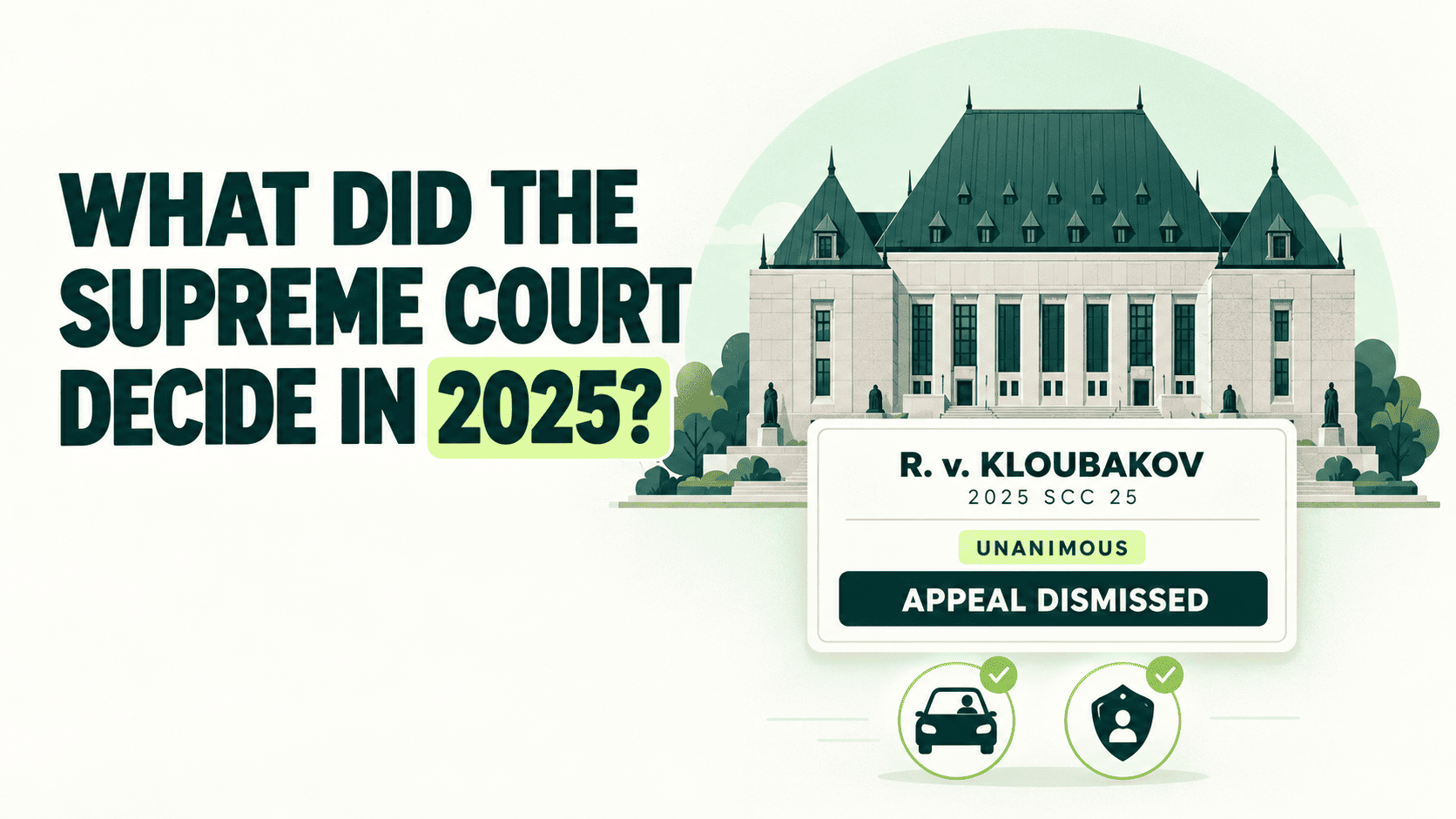
On July 24, 2025, the Court unanimously dismissed their appeal. It held that, properly interpreted, the offences did not prevent the safety measures discussed in Bedford and did not violate sex workers’ security-of-the-person rights under section 7 on the challenge presented.
The Court explained that the law permits hiring drivers, security personnel, and others for safety. It also distinguished procuring from activities such as renting space or offering safety advice.
The ruling upheld the convictions. It did not create a blanket exemption for everyone who describes their work as protective assistance. Equally, it did not decide the constitutionality of every provision introduced through Bill C-36 under every possible Charter argument.
How Should Readers Understand Other Legal Challenges?
A broader challenge reached the Ontario Superior Court in Canadian Alliance for Sex Work Law Reform v. Attorney General, 2023 ONSC 5197. The court dismissed that application. The published decision concerns several provisions and Charter arguments, making its scope different from Kloubakov.
When reading coverage of litigation, four questions help:
- Which provision was challenged? A judgment about procuring may not decide the purchasing offence.
- Which court issued the decision? The court’s position in the judicial system affects the ruling’s authority.
- What did the court actually order? Dismissing an application, staying a prosecution, and declaring a provision invalid have different consequences.
- Was there a later decision? An appeal may change the outcome reported in an earlier headline.
A report that describes a law as “challenged” establishes that someone disputed it. It does not, by itself, establish that the law stopped applying. Similarly, a successful argument about one issue does not answer every other issue in the case.
This is why a current legal explanation should connect its status statement to the legislation and identify the scope of important judgments.
Does Bill C-36 Affect Websites And Online Advertising?
It can. Justice Canada’s fact sheet explains that the advertising offence can apply to websites and publishers that knowingly carry advertisements offering another person’s sexual services for payment.
The guidance also describes powers to seize advertising material or order its removal from the internet. A person’s protection from prosecution for advertising their own services does not necessarily prevent a removal order affecting that material.
For a website operator, the relevant starting point is the service being promoted and the operator’s involvement. A general label such as “adult website” gives too little information to determine the legal position.
Nothing in this framework establishes a general rule that an “18+” pop-up makes an otherwise prohibited advertisement lawful. Age controls and criminal restrictions on particular services answer different questions. A website’s terms, disclaimers, or audience settings cannot substitute for assessing the actual activity.
How Can Shopify Merchants Manage Cookie Choices With Consentik?
If you run a Shopify store, reviewing website rules may also raise a practical question: can visitors choose how your store uses cookies and tracking tools? A clear consent setup makes those choices easier to understand and manage.
Consentik GDPR Cookie Banner helps with that part of your store. It does not determine whether your products, services, or advertisements are lawful under Bill C-36.
Give Shoppers Clear Choices And Keep Useful Records
Consentik combines a customizable cookie banner with a preferences popup. You can match the design to your store and give visitors a place to manage cookie choices. Its cookie scanner helps identify cookies, while tracking-script blocking and consent logs support the work behind the banner.
What Else Can Consentik Help With?
| Feature | Why it helps your store |
| Google Consent Mode V2 | Connect consent choices with supported Google tracking tools. |
| Multilingual banners and geotargeting | Adapt the experience for different languages and locations. |
| Data request management | Organize customer privacy requests. |
| Consent reports and scheduled log exports | Review choices and keep records for internal checks. |
| Headless support and cross-domain consent sharing | Support more complex storefront setups. |
| Accessibility widget | Offer controls such as font size and contrast adjustments. |
| EU withdrawal form | Add a separate form for contract-withdrawal requests. |
Features vary by plan. The Shopify listing includes a free plan, a demo, and paid-plan comparisons.
Is Sex Work The Same As Human Trafficking Under This Law?
The Criminal Code defines separate offences. Section 279.01 concerns conduct such as recruiting, transporting, harbouring, or controlling a person for the purpose of exploiting them or facilitating their exploitation.
The purchasing offence does not require the prosecution to prove that separate trafficking offence. Conversely, trafficking allegations require analysis of their own legal elements.
These offences can arise within the same investigation, but the terms should not be used interchangeably. A report about purchasing charges is not automatically a report about trafficking convictions.
Keeping the distinction clear also improves public discussion. It allows readers to examine exploitation, adult consent, coercion, and criminal liability without assuming that a single label answers every question. The correct legal description depends on the conduct and evidence.
Why Is Bill C-36 Still Debated?
The debate concerns both the law’s aims and its effects. Justice Canada’s technical paper describes the government’s demand-reduction approach and its view that reducing prostitution helps address exploitation and inequality.
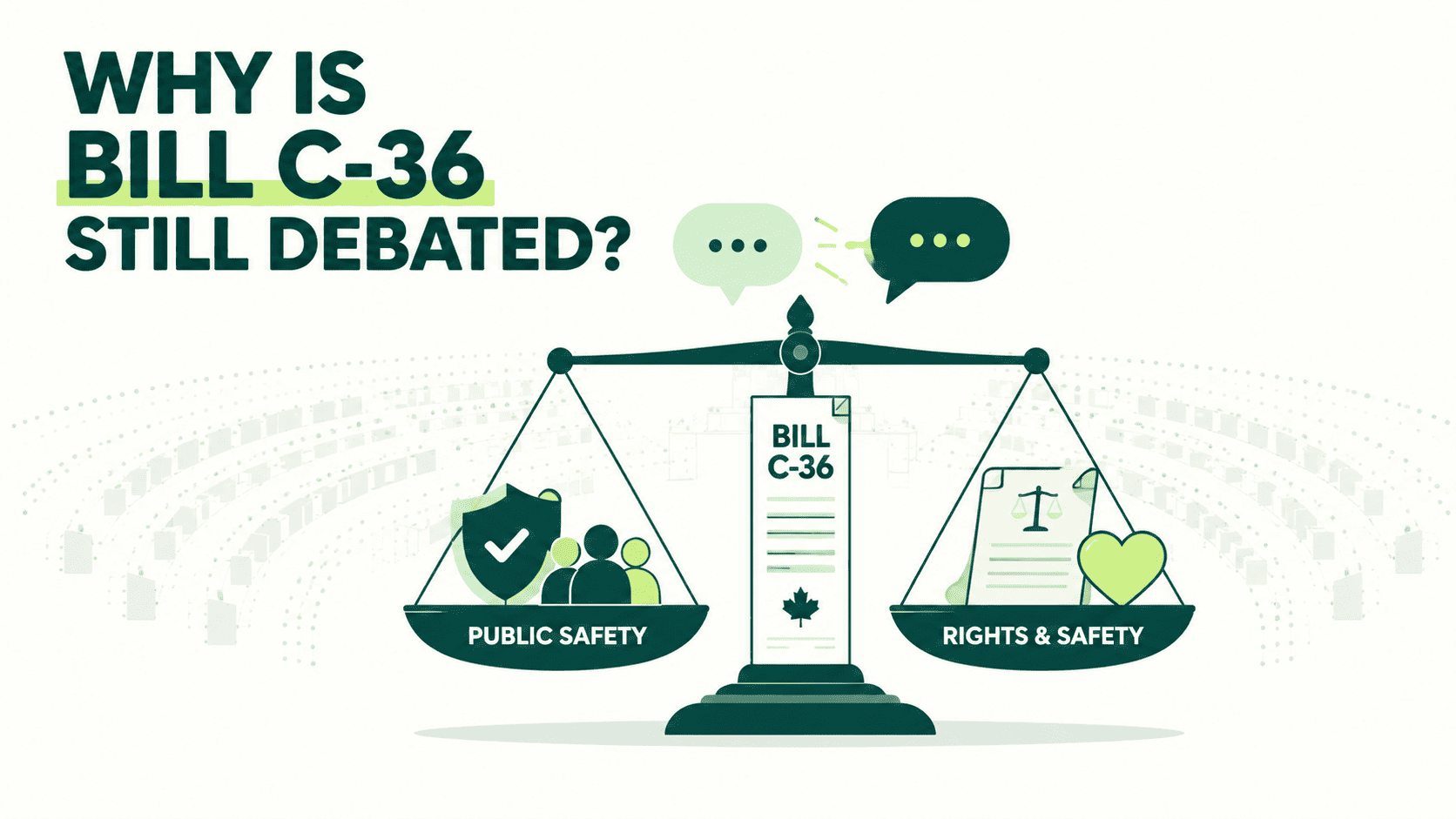
Supporters argue that criminalizing purchasers and exploitative third parties directs responsibility toward those creating demand or profiting from others. They also emphasize community protection and support for people who want to leave the sex industry.
Critics argue that criminalization can still affect sellers even when buyers are the main targets. Concerns include rushed screening, hidden working conditions, stigma, and reluctance to seek assistance.
The House of Commons Justice Committee examined these competing views in its 2022 review of PCEPA. Witnesses described varied experiences, and the report addressed safety, access to services, and reform. It also recommended extensive consultation before amendments or related policies.
These discussions concern how the law works in people’s lives. A judgment on constitutionality and a policy assessment answer different questions: a provision can survive a particular Charter challenge while its effectiveness remains contested.
What Do Enforcement Figures Show?
Statistics Canada reported that police-recorded crimes related to the sex trade fell by 55% between 2010 and 2019. That period spans years before and after the 2014 changes.
The figures describe recorded offences, rather than the total amount of sex work or every instance of harm. The offences themselves changed, and enforcement practices influence what appears in police data.
A fall in recorded incidents therefore cannot, on its own, prove that demand fell by the same amount or that everyone became safer. It also cannot establish that every change resulted from Bill C-36.
Evaluating the law requires matching evidence to the claim being made. Police records can inform questions about enforcement. Claims about violence, health, working conditions, or access to support need evidence that measures those outcomes. The 2010–2019 study should also be presented as historical research, not as a current-year estimate.
Final Words
Bill C-36 remains relevant because its rules continue to shape criminal liability in Canada’s sex industry. Understanding those rules requires attention to the specific activity, the exceptions, and the courts’ interpretation.
Future debates may lead to further legislative or judicial developments. Until a change takes legal effect, a proposal for reform does not replace the existing rules. Readers following this issue should look for an enacted amendment or a clearly identified court order, along with its effective date and scope.