The SECURE Data Act would set national rules for how businesses collect, use, share, and protect personal information. For a business serving customers across several states, it could change both the rights customers have and the steps needed to respect them.
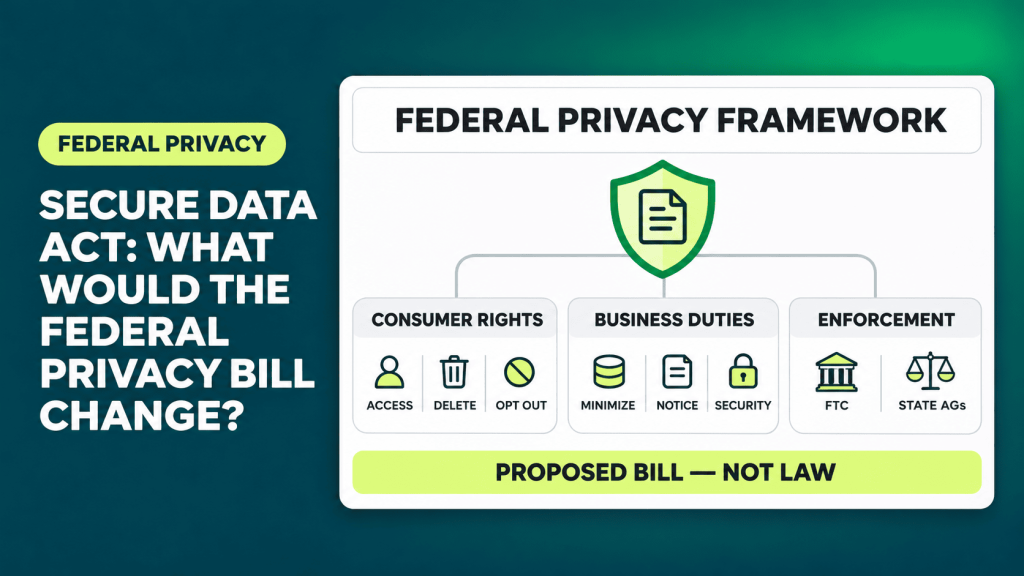
The draft reviewed here is a proposal. Its requirements would depend on Congress passing the bill, and businesses must still follow the laws that apply to them today.
To understand what it could mean for your business, start with three questions: would it cover you, what could customers ask you to do, and which parts of your data practices would need to change?
What is the SECURE Data Act, and has it passed?
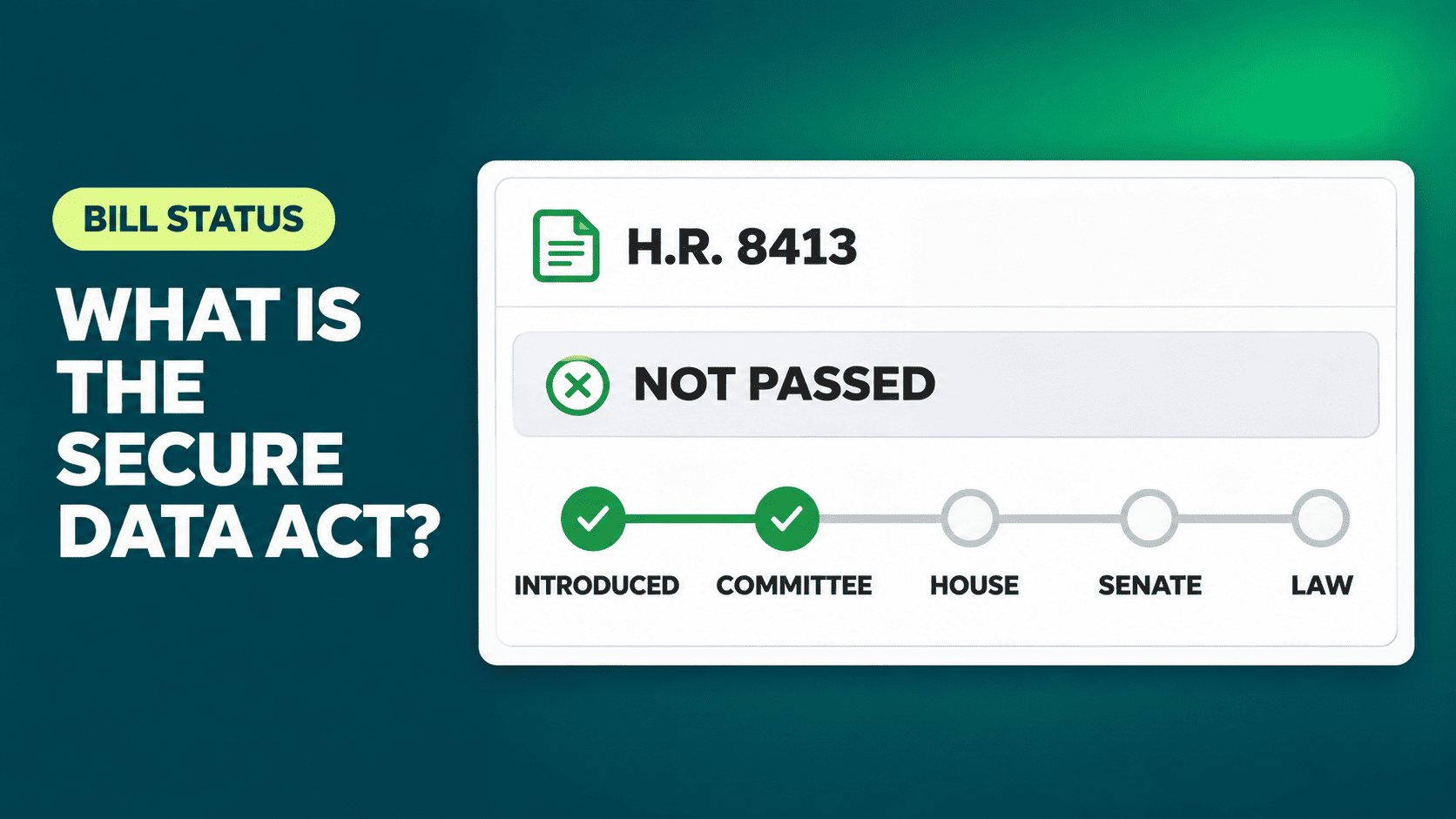
SECURE stands for Securing and Establishing Consumer Uniform Rights and Enforcement over Data. Representative John Joyce introduced H.R. 8413 on April 21, 2026. The bill was referred to the House Committees on Energy and Commerce and the Judiciary.
The House Commerce, Manufacturing, and Trade Subcommittee held a hearing on the proposal on June 3, 2026. A hearing allows lawmakers to examine a bill and hear evidence; it does not make the proposal law.
At the October 10, 2026 research review, the SECURE Data Act had not become law. A September 30 policy update from i2Coalition reported that committee leaders had not scheduled a markup. No enacted version was identified in the sources reviewed.
The bill’s sponsors describe it as a way to provide a uniform national privacy and security standard. The bill would give consumers federal privacy rights while preventing states from enforcing many rules on the same subjects.
Which businesses would the SECURE Data Act cover?
The proposal would apply to qualifying businesses and other persons covered by the Federal Trade Commission Act, as well as certain telecommunications providers known as common carriers. To fall within its scope, they would need a connection to U.S. consumers and meet one of the two tests below.
That connection could be doing business in the United States, offering products or services to U.S. residents, or processing or selling their personal data. In this context, processing includes activities such as collecting, storing, using, and sharing information.
Under Section 13 of the introduced bill, the thresholds are:
| Coverage route | Annual consumer-data threshold | Revenue condition |
| General route | Collect and process personal data of more than 200,000 consumers | Annual gross revenue of at least $25 million, subject to inflation adjustment |
| Data-sale route | Collect and process personal data of at least 100,000 consumers | At least 25% of annual gross revenue comes from selling that personal data |
A business must meet both conditions in either row. Earning $25 million alone would not meet the first test. For the second test, the bill does not set a separate $25 million revenue minimum.
Information used only to complete a payment is left out of these consumer counts. But a purchase record also used for advertising or building a customer profile would need a separate review. Being connected to a payment would not, by itself, qualify the record for this exclusion.
For example, a retailer with $30 million in revenue and data on 150,000 consumers would not meet the first route. Whether it meets the second depends on its data-sale revenue and the other conditions.
Which organizations and data would be exempt?
The bill exempts government bodies, qualifying nonprofits, colleges and universities, and certain other organizations. Exemptions also include financial institutions covered by the Gramm-Leach-Bliley Act and organizations and business associates covered by the Health Insurance Portability and Accountability Act, or HIPAA.
Separate exclusions cover certain employment records, health records, education records, consumer reporting information, research data, and financial information.
Check what each exemption covers. Some apply to an organization; others apply only to particular information. Having one exempt dataset would not necessarily put the whole business outside the bill.
A business below the proposed thresholds may still have duties under state privacy laws or other federal laws.
What would count as personal and sensitive data?
Personal data is information that identifies someone or can reasonably be connected to them. A name or email address is an obvious example. Other records can also count if they allow a business to identify the person involved.
The definition leaves out publicly available information and deidentified data, meaning information that cannot reasonably be linked back to a person. The bill protects people acting for personal or household purposes. Its definition of a consumer excludes people acting in a business or employment role.
Sensitive data would receive additional protection. The definition includes:
- Data disclosing racial or ethnic origin, religious belief, a mental or physical health diagnosis, sexual orientation, or citizenship or immigration status.
- Genetic or biometric data processed to identify a specific person uniquely.
- Personal data collected from a child or teen.
- Precise geolocation data.
The proposal defines a child as someone under 13 and a teen as someone aged 13 through 15. It does not extend that specific teen definition to everyone under 18.
What privacy rights would consumers have?
Section 2 would give consumers several ways to control personal data held by a covered controller. A controller determines why and how information is processed. A processor handles it on the controller’s behalf.
| Proposed right | What it would allow |
| Access | Confirm whether data is being processed and obtain a copy, subject to the trade-secret exception |
| Correction | Request correction of inaccurate information, considering its nature and use |
| Deletion | Request deletion of information provided by or obtained about the consumer |
| Portability | Receive previously provided digital data in a usable, portable format where technically feasible |
| Opt-out | Stop covered targeted advertising, data sales, and certain solely automated decisions |
There would be exceptions. Section 11 allows specified activities, including providing a service the customer requested, defending a legal claim, or dealing with fraud and security incidents. A deletion request would not always require a business to erase every record immediately.
How quickly would businesses need to respond?
A controller would need to respond without unnecessary delay and normally within 45 days. If the number or complexity of requests makes an extension reasonably necessary, it could take another 45 days. It would have to tell the consumer why before the initial deadline expires.
For each right, a consumer could submit two free requests to each controller per year. The bill sets conditions for charging an administrative fee or refusing further requests, including requests that cannot technically be carried out or are clearly unfounded.
If a controller refuses a request, it would need to explain why and provide appeal instructions. The appeal response would be due within 60 days. A denied appeal would also need to direct the consumer to a way to complain to the FTC or a state attorney general.
A business could require use of an existing account, but could not require someone to create a new account just to exercise these rights.
When would consent be required?
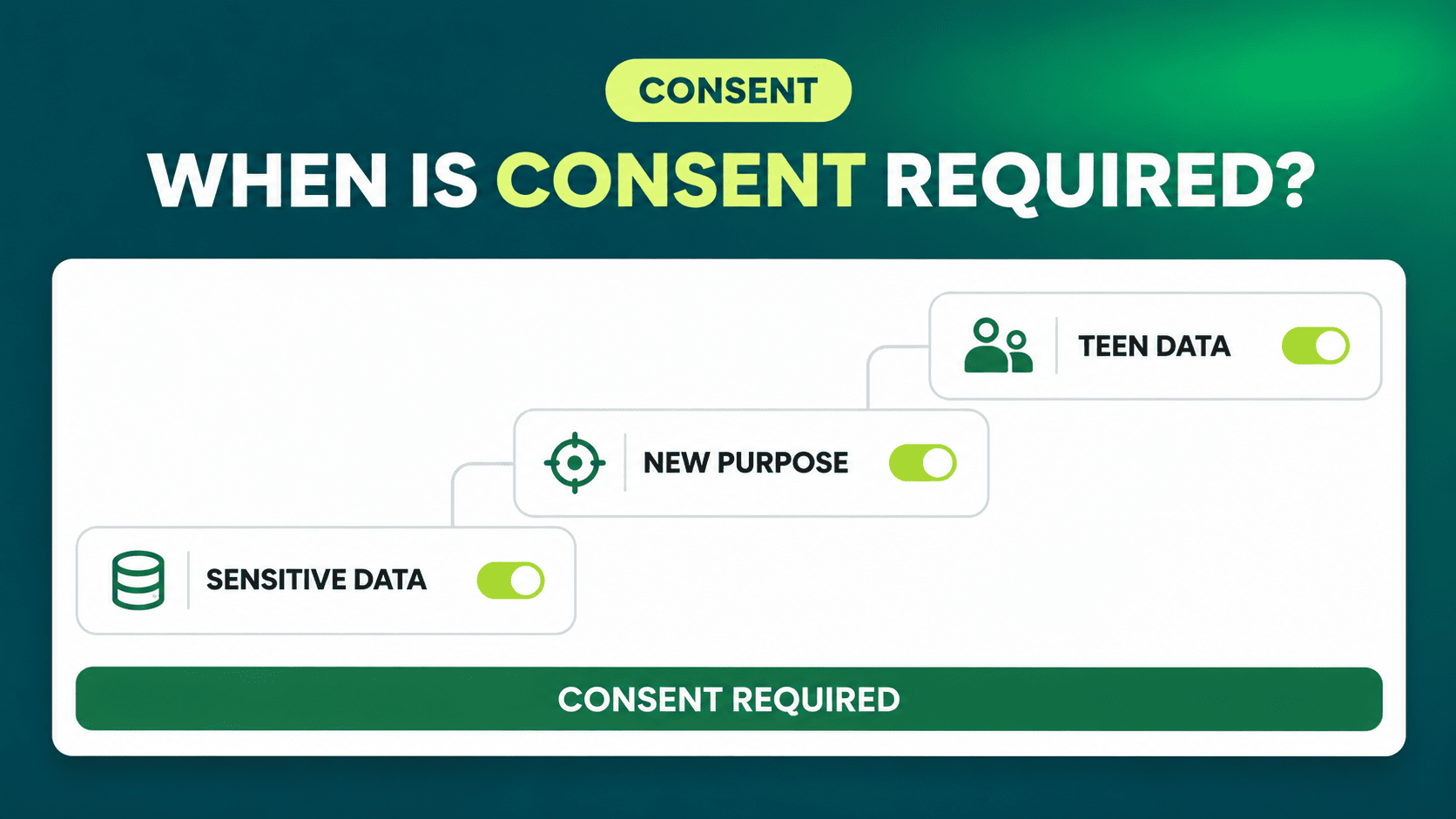
The SECURE Data Act would require consent before processing sensitive data, with separate rules for children and other exceptions in the bill. Consent would mean a clear action showing that someone freely agreed, understood the choice, and agreed to the specific use of their information.
A consent request should explain what information the business wants and how it plans to use it. Showing a privacy notice alone would not demonstrate that the person actively agreed.
Children’s sensitive data would be handled in accordance with the Children’s Online Privacy Protection Act, or COPPA. Processing a teen’s sensitive data would require verifiable parental consent. Because the sensitive-data definition includes personal data collected from children and teens, this protection would extend beyond details such as location or health diagnoses.
A controller would also need consent for a new use that is neither reasonably necessary nor compatible with the purpose it told the consumer about.
For example, a business collecting details to deliver a service would need to review an unrelated later use separately. Permission to collect information for one purpose would not automatically settle whether the business could use it for another.
How would the bill affect advertising, cookies, and profiling?
The proposal would create opt-out rights for targeted advertising and the sale of personal data. It would not impose one blanket consent rule on every cookie or every use of ordinary personal data.
Its targeted-advertising definition focuses on ads selected using a consumer’s activity over time and across unrelated websites or apps. It excludes certain activities, including contextual advertising, ads based on activity within the controller’s own site or app, and processing solely for advertising measurement or reporting.
The data-sale definition is also specific: it concerns an exchange for money. It includes exceptions for certain processor disclosures, affiliate transfers, requested services, and corporate transactions.
Marketing teams would need to check what their tools actually collect and share. A vendor’s label, such as “analytics” or “personalization,” would not be enough to determine which rules apply. The introduced bill would not generally require businesses to honor Global Privacy Control, although current state laws may still require it.
What duties would businesses and service providers have?
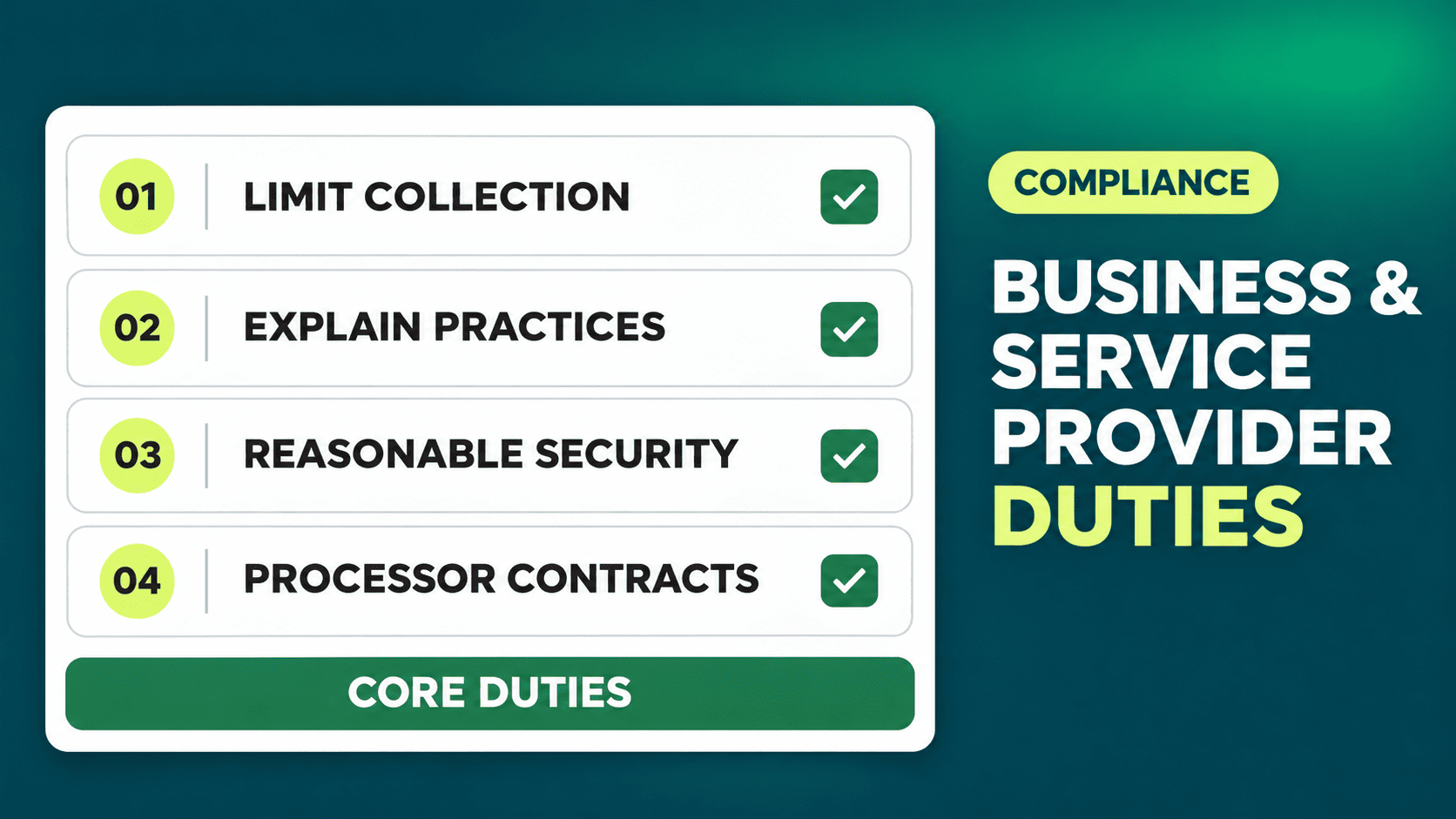
A privacy notice would be only one part of the work. Covered businesses would also need to review their data collection, security measures, and agreements with service providers.
Limit collection and incompatible uses
Controllers would need to limit collection to information that is adequate, relevant, and reasonably necessary for the purposes they disclose. They would also need consent for uses that are neither reasonably necessary nor compatible with those purposes.
Explain practices before processing
The privacy notice would need to identify data categories, processing purposes, rights-request methods, and appeal procedures. It would also describe categories shared with other controllers or government entities and the categories of recipients.
Maintain reasonable security
Section 4 would require security measures suited to the amount and type of information held, including how sensitive it is. Those measures would need to protect information against unauthorized access and improper changes, while keeping it available when needed.
Put processor duties into contracts
Section 6 would require contracts setting out processing instructions, purposes, data types, duration, and each party’s duties. They would also cover confidentiality, deletion or return of data, compliance information, assessments, and subcontractor obligations.
Businesses would also face limits on treating customers differently because they exercised their privacy rights. The bill allows specified differences connected with voluntary loyalty and rewards programs.
What would change for data brokers?
The proposal defines a data broker as a controller that collects information about people who are not its customers or users and derives 50% or more of its annual gross revenue from selling that information. Covered brokers would need to post a clear notice, explain how consumers can use their rights, and register with the FTC each year. The FTC would maintain a public directory, but the bill does not create one request that removes a person’s data from every broker.
Would the SECURE Data Act replace state privacy laws?
Section 15 would broadly prevent states and local governments from making or enforcing rules related to the bill’s provisions. This is called preemption: federal law takes priority over state law within the area it covers.
A national standard could simplify compliance for businesses operating across several states, but critics argue that it could remove stronger state protections. Until the bill becomes law, businesses must continue following the state privacy laws that apply to them.
How does the proposal compare with California’s CCPA?
The CCPA is already in force in California, while the SECURE Data Act remains a federal proposal. Both address consumer privacy rights and advertising choices, but their coverage and opt-out rules differ. The federal bill would be enforced by the FTC and state attorneys general and would not create a private right of action. Businesses subject to the CCPA could reuse parts of their current privacy process, but they would still need to review the final federal rules separately.
Who would enforce the law, and what penalties could apply?
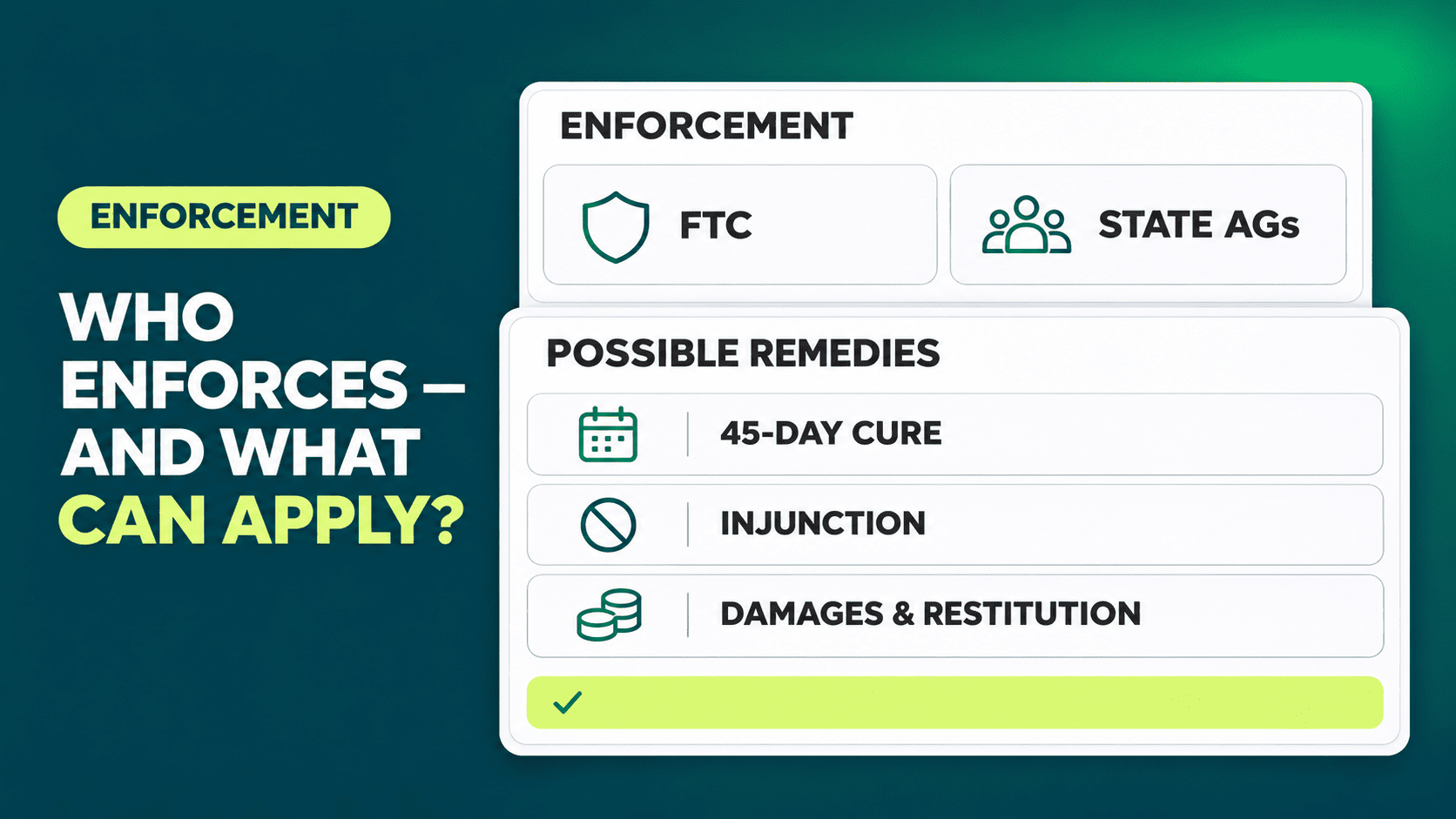
The Federal Trade Commission (FTC) and state attorneys general would have principal enforcement roles under Section 12. The proposal does not create a private right of action allowing consumers to sue directly under the Act.
Before starting an enforcement action, the FTC or a state attorney general would generally have to explain the alleged violation in writing and give the business at least 45 days to fix it. This is called a right to cure. The business would need to correct the problem and provide the required written assurance that it will not happen again; failing to do so, or continuing to violate the Act, could lead to enforcement.
When would the proposed requirements take effect?
If enacted, the consumer-rights, security, and data-broker provisions would generally begin after one year. Most other provisions would take effect after two years, so businesses should confirm the final deadlines if the bill advances.
How Can Consentik Help Online Stores Manage Customer Privacy Choices?
For an online store, privacy work often comes down to a few everyday tasks: explaining cookie choices, controlling tracking, and keeping a record of what customers agreed to. These are useful areas to review while following the debate around the SECURE Data Act.
Consentik brings several of those tasks into one app. Its features include:
- Branded banners and preferences: Match the wording and design to your store.
- Cookie scanning: Find cookies to review.
- Script blocking: Configure supported tracking scripts around consent requirements.
- Google Consent Mode V2: Connect customer choices with Google tracking.
- Consent logs and data requests: Record choices and organize requests.
- Global Privacy Control support: Recognize supported browser privacy signals.
- Languages and geotargeting: Adapt banners for different markets.
Selected plans also include Microsoft UET Consent Mode, IAB TCF support, scheduled log exports, consent statistics, headless storefront support, and consent sharing across domains. Other tools include a policy-page generator and an accessibility widget. Availability varies by plan.
These tools support part of your privacy work. You would still need to review data uses, contracts, security, and legal requirements separately. Installation alone would not establish compliance with a future SECURE Data Act.
To see which features fit your store, explore Consentik and compare the plans with your tracking tools and customer markets.
Final words, what can businesses prepare now?
The SECURE Data Act may change what businesses must do with personal data. For now, focus on making privacy choices clear and easy for customers to use. A customer who asks to stop tracking or delete their information should know what happens next. Getting that experience right is a useful place to start.