If you run a store and sell to customers in Europe, there’s a privacy update you can’t afford to ignore. The IAB Transparency & Consent Framework just got a major upgrade, and version 2.3 is set to become mandatory by February 2026.
So what does this mean for your store? This guide breaks down everything you need to know about IAB TCF 2.3, from what’s actually changing to how you can prepare your store for compliance. We’ll keep things straightforward and practical, because that’s what matters when you’re running a business.
Key Updates in TCF 2.3
Key Dates to Remember
| Date | What Happens |
| June 19, 2025 | TCF v2.3 released |
| February 28, 2026 | Transition period ends |
| March 1, 2026 | TC Strings without the disclosedVendors segment are invalid |
Important note: TC Strings (Transparency & Consent String) created before March 1, 2026, without the disclosedVendors segment remain valid until users renew or change their choices.
Stricter Transparency Requirements
The biggest focus of TCF 2.3 is improving what users actually see and understand. Gone are the days of vague, confusing consent banners. Your consent banner now needs to meet higher standards that prioritize clarity:
- Show the vendor count upfront. The first screen of your banner must tell users how many vendors will process their data. Instead of hiding this detail, you might say something like “Our 54 partners use cookies…”
- Use plain language with examples. Legal jargon is out. Every purpose description needs concrete examples. Instead of “we process data for personalization,” try “e.g., to show you ads for products you might like.”
- Make the banner easy to reopen. Users must be able to pull up their consent settings anytime with minimal effort. A floating “Privacy Settings” button works well for this.
These aren’t suggestions. IAB Europe will publicly flag CMPs or sites that don’t comply and could refer serious offenders to regulators.
New Technical Requirements
TCF 2.3 adds a new required field called “Disclosed Vendors” to every consent string. It’s a technical change, but it fixes a very real confusion from older versions.
Before, vendors could see that they didn’t have permission – but they couldn’t tell why. Did the user see the vendor and say no? Or was the vendor never shown to the user in the first place?
That difference matters. Some vendors can only operate (for things like fraud prevention) if users were told about them. Without a clear signal, vendors didn’t know whether they were allowed to do anything at all.
With TCF 2.3, this is now clear. Each vendor gets a simple yes/no flag:
- 1 = the vendor was shown to the user
- 0 = the vendor was not shown
If a vendor wasn’t disclosed, they know they must not process data. No guessing, no gray area.
💡 Pro Tip: How to verify your new TCF 2.3 strings
With the addition of the mandatory “Disclosed Vendors” segment, TC Strings are becoming more complex. If you want to verify that your consent banner is generating strings correctly, you can use our TCF Decoder. Simply paste your string to see exactly which vendors are being disclosed and which purposes have received consent, ensuring your technical setup matches your legal requirements.
Legitimate Interest Restrictions
TCF 2.3 further limits the use of “legitimate interest” for advertising. For personalized ads and content, consent is now the only valid option. Vendors can no longer say they have a business reason to track users without asking them first. This is a big change from how online advertising worked in the past.
For store owners, this actually makes things simpler. Users won’t see confusing options where some vendors rely on “legitimate interest” while others ask for consent for the same purpose. Everyone follows the same rule: ask first. That means a cleaner consent banner and a clearer experience for your customers.
Here is a comparison table of IAB TCF 2.3 to previous versions:
| Feature | TCF 2.0 (2020) | TCF 2.2 (2023) | TCF 2.3 (2025) |
| Disclosed Vendors Segment | Optional | Optional | Mandatory |
| Vendor Disclosure Clarity | Ambiguous signaling for all vendors | Resolved for Special Purpose-only vendors (2021 update) | Fully resolved for all vendor types |
| Legitimate Interest for Personalized Ads | Allowed | Removed for Purposes 3, 4, 5, 6 | Removed for Purposes 3, 4, 5, 6 |
Legal Background: Why These Changes Were Necessary
The TCF was built to help businesses follow GDPR, but regulators have been keeping a close eye on it.
Back in 2022, regulators in Belgium said the old versions of TCF didn’t fully meet GDPR rules. That decision kicked off a series of court cases that forced the industry to rethink how consent works. The result is TCF 2.3. And it wasn’t created just because “it felt right,” but because the courts demanded real changes.
Key legal points from recent rulings:
- Consent data is still personal data
Even though a consent string looks technical, courts confirm it can still be linked to a real person (for example, through an IP address). So it needs to be treated with the same care as an email address or customer profile – not as a harmless system log.
- IAB Europe has responsibility, but not for everything
The courts also clarified who’s responsible for what. IAB Europe is accountable for how consent signals are created and shared through the TCF. But once that signal reaches advertisers or vendors, they are responsible for how they use the data.
Why does this matter to you? Managing consent isn’t just a checkbox or a plugin you install and forget. It has legal weight.
TCF 2.3 exists because real regulators and real courts found real problems – and fixed them.
So when you use it, you’re relying on a framework that’s been shaped by legal reality, not just industry promises.
In short: this is about protecting users, protecting your business, and staying on the right side of the law – without having to be a lawyer yourself.
What This Means for Your Store
For most Shopify merchants, TCF 2.3 isn’t scary or complicated. It really comes down to four practical things. You don’t need to do everything today – but you do need to pay attention before the deadline.
Update Your CMP
Your Consent Management Platform needs to support TCF 2.3 before the deadline. Most popular CMPs like OneTrust, Cookiebot, and Didomi are already rolling out updates. If you’re using a Shopify app for GDPR compliance, check with the developer about their TCF 2.3 timeline. Don’t assume it will happen automatically. Reach out and confirm.
Check Your Vendor List
Every tool that tracks users on your store needs to be officially registered under TCF 2.3.
This includes things like:
- Google Analytics
- Facebook / Meta Pixel
- Email marketing tools
- Any other tracking or ad scripts
If a tool isn’t on the Global Vendor List, it won’t be covered by consent.
Simple tip:
- Make a short list of everything running in your store, then double-check each one.
- This is often eye-opening – many stores have more scripts than they realize.
Update Your Consent Banner
Your banner needs to:
- Clearly say how many vendors are involved
- Use plain, understandable language
- Let users reopen and change their choices easily
Most CMPs handle this for you – but configuration still matters.
Keep Consent Records
TCF 2.3 puts more weight on proof. Your CMP should log:
- When a user gave consent
- What choices did they make
- How that consent was collected
This matters if regulators ever ask questions.
How Consentik Helps Store Owners Get Compliant With IAB TCF 2.3
After February 1, 2026, old TCF 2.2 consent strings stop working.
For most store owners, the hardest part of IAB TCF 2.3 isn’t understanding the rules – it’s implementing them correctly without disrupting tracking, advertising, or the customer experience. Consentik is designed to help businesses apply TCF 2.3 requirements in a clear, manageable way.
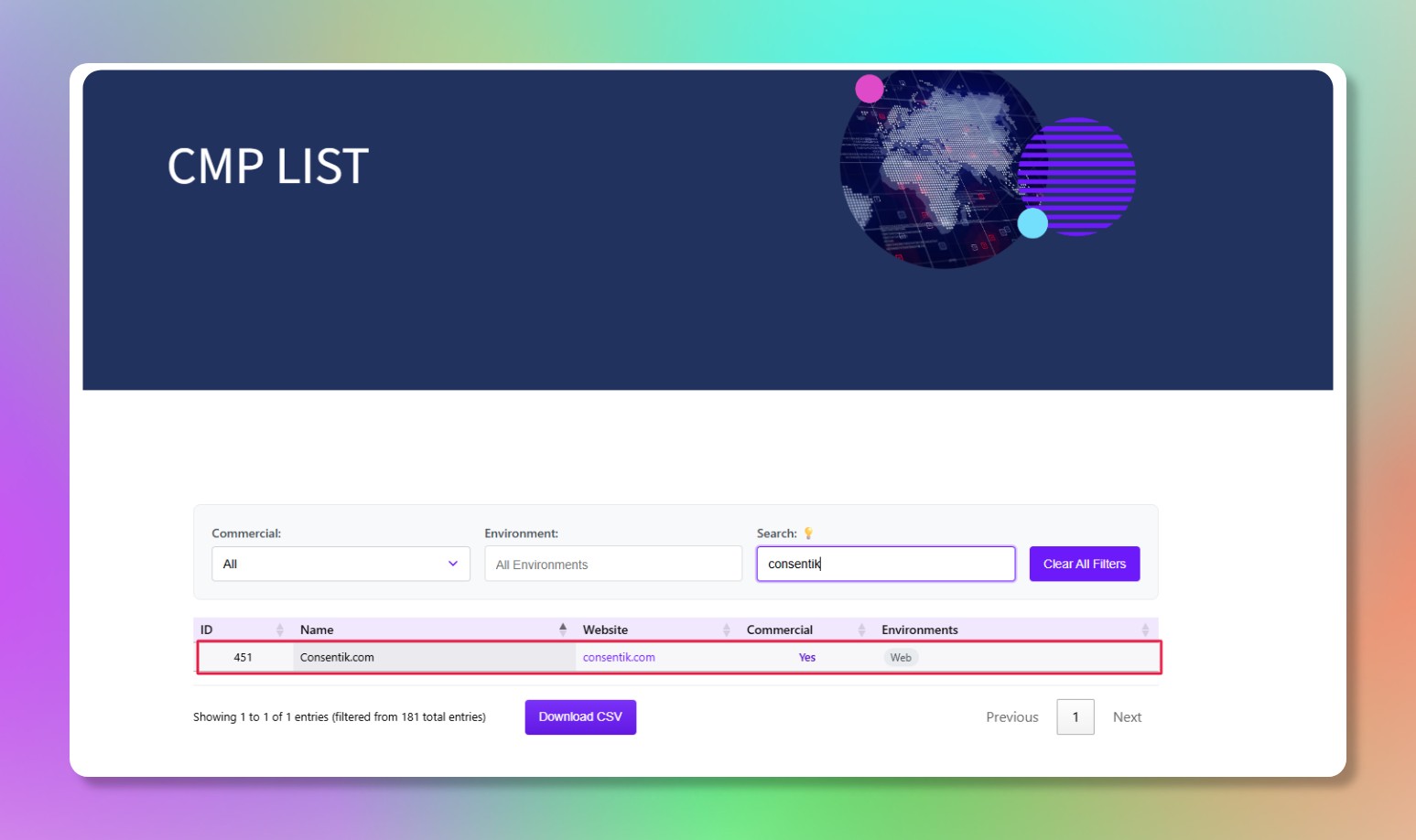
As an IAB Europe-certified CMP, Consentik will automatically update to TCF 2.3 requirements, so you can focus on running your store, not chasing compliance deadlines. Check out Consentik on the official IAB Europe CMP List so you can see the real action and impact!
TCF 2.3–ready consent banners
Consentik supports the latest transparency requirements, including displaying vendor counts, using plain-language purpose descriptions, and allowing users to easily reopen and adjust their consent preferences.
Works across platforms and ad ecosystems
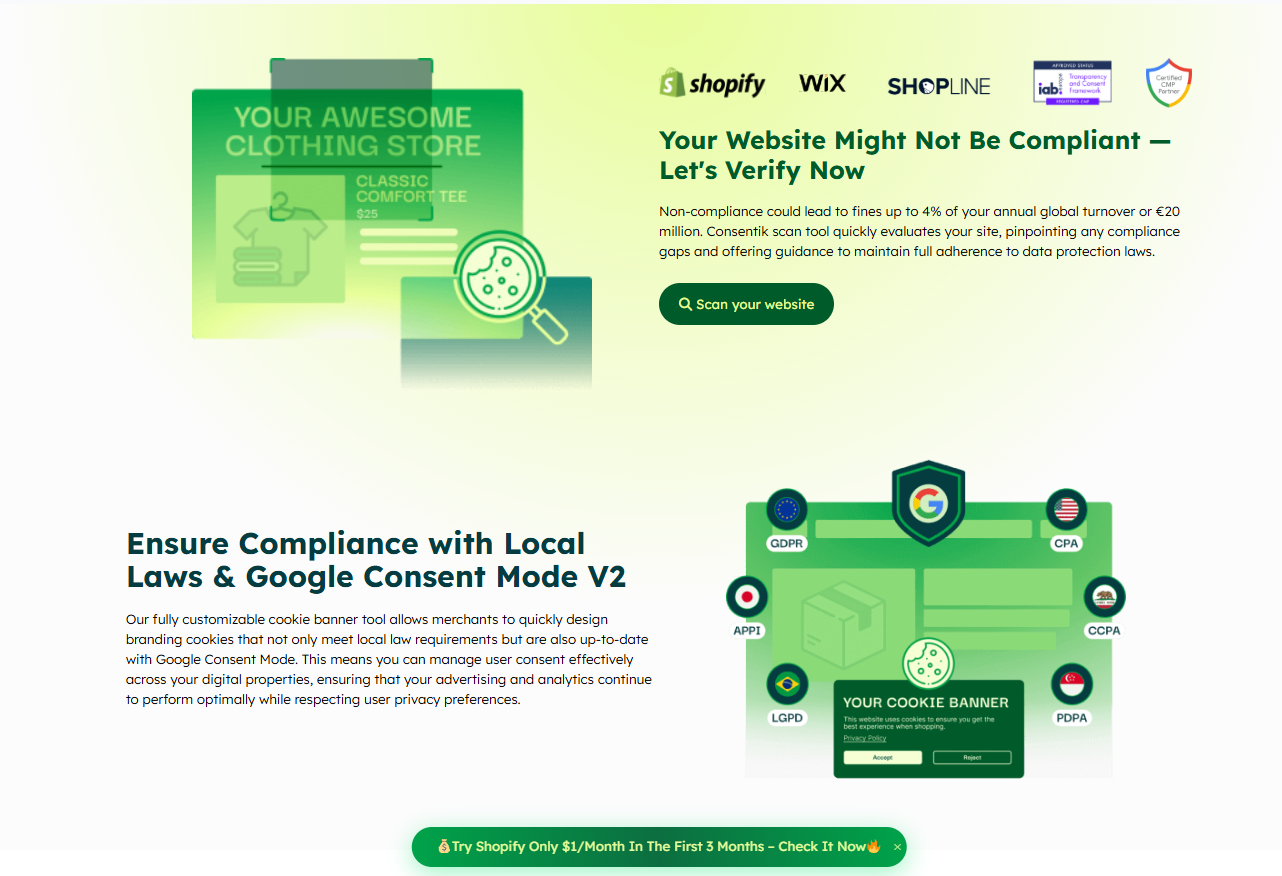
As a Google CMP Partner and Microsoft-approved CMP, Consentik is built to work across multiple platforms and advertising systems. It offers dedicated solutions for Shopify, Wix, Shopline and other platforms, helping store owners manage consent consistently even when operating across different platforms.
Built-in vendor disclosure support
TCF 2.3 requires vendors to know whether they were shown to users. Consentik handles this behind the scenes by aligning consent signals with the IAB Global Vendor List and the new “disclosed vendors” requirement, reducing ambiguity and compliance risk.
Consent-first advertising tracking
With TCF 2.3 restricting the use of legitimate interest for personalized advertising, Consentik ensures marketing-related tracking only runs after users give explicit consent. This keeps your advertising setup aligned with current legal expectations.
Reliable consent logging
Consentik records when consent was given, what choices were made, and how consent was collected. These records help businesses stay prepared in case of audits or partner compliance checks.
Designed for evolving privacy standards
Privacy rules continue to change, and consent frameworks evolve with them. Consentik is built to adapt to future TCF updates, helping store owners maintain compliance without constant rework.
Three Steps to Get Compliant With IAB TCF 2.3
Getting ready for TCF 2.3 doesn’t have to be overwhelming. Break it down into manageable pieces and tackle them one at a time.
Step 1: Get a basic understanding
Read:
- The TCF 2.3 overview from IAB
- Your CMP’s migration or update guide
You don’t need to become an expert. You just need enough context to feel confident when checking your setup or talking to vendors.
Step 2: Review your vendor list early
If a tool you rely on isn’t planning to support TCF 2.3, that’s a problem. Better to find out now and switch tools calmly. Than panic later when something breaks
Step 3: Update and test like a real user
Before the deadline:
- Update your CMP (ideally on staging first)
- Test on desktop and mobile
- Accept and reject consent options yourself
- Confirm tracking tools behave correctly
Most issues are easy to fix – if you catch them early.
What Happens If You Don’t Comply?
Ignoring TCF 2.3 isn’t just about missing a checkbox. There are real consequences that can affect your revenue, reputation, and legal standing. Here’s what you’re looking at if you skip this update:
- Public flagging: IAB Europe may publicly list non-compliant sites, and ad vendors could stop working with you.
- Ads and tracking break: Outdated consent can be treated as “no consent,” causing analytics and remarketing to stop.
- Legal penalties: GDPR fines are real. Even small stores have been fined for improper cookie consent.
- Regulatory attention: Non-compliance may be reported to authorities, leading to audits and investigations.
Final Thoughts
TCF 2.3 isn’t just a technical change. It’s part of a bigger shift toward clearer, more respectful data use in digital advertising. For store owners, adopting it shows customers, partners, and regulators that privacy matters to you, and that trust is increasingly important today.
You have until February 2026, but starting early makes a big difference. Talk to your CMP provider, review your vendors, and test updates now to avoid last-minute stress and broken setups. When users understand what they agree to, their consent is more meaningful. TCF 2.3 helps build that trust – and gives your business a compliance foundation that can grow as expectations change.
Meet the requirements of the IAB TCF 2.3 to serve ads to your visitors without interruption
Make privacy compliance easy for Shopify and Wix stores

![2026 Latest Data Privacy Violations [With Real Cases]](https://consentik.com/wp-content/uploads/2025/12/Data-Privacy-Violations-150x150.png)