Ever wondered how websites manage to keep track of all those privacy preferences while staying compliant with data protection laws? That’s where the IAB Transparency and Consent Framework (TCF) comes in, and it’s just received a significant update. If you’re running a business that handles user data or digital advertising, you’ll want to pay attention to these changes.
What is IAB TCF 2.2?
IAB TCF 2.2 is IAB Transparency & Consent Framework version 2.2, the current version of a framework released in 2023 that helps companies navigate the complex waters of data protection regulations like GDPR. But unlike its predecessors, version 2.2 brings some game-changing improvements to the table.
The update brings several substantial changes that reshape how businesses handle personal data:
First, there’s a fundamental shift in how companies can process data for advertising. TCF 2.2 now requires explicit user consent for advertising and content personalization – legitimate interest is no longer accepted as a legal basis. This aligns with recent Data Protection Authority decisions and strengthens user privacy rights.
Second, the IAB TCF 2.2 framework also demands greater transparency in user interactions. Businesses must make their privacy controls more accessible, allowing users to easily modify their consent preferences at any time. Consent Management Platforms (CMPs) must now display the total number of vendors seeking data access right on the first screen, along with clear, example-rich descriptions of how data will be used.
Finally, technical changes are equally significant. The framework deprecates the getTCData command, requiring vendors to use event listeners for obtaining TC strings instead. This affects all parties in the ecosystem:
- Publishers need to update their CMPs
- Advertisers must verify their vendors’ compliance
- Vendors must adapt their systems to the new requirements
Note: After February 1, 2026, legacy TCF 2.2 consent strings stop working and are succeeded by IAB TCF 2.3 and the subsequent TCF v2.4 technical specification. For the newest requirements – including Google’s August 2026 IP-based measurement change and mid-October 2026 TCF v2.4 rules – see our updated guides on IAB TCF compliance.
The evolution to IAB TCF 2.4 (2026)
Building directly on the transparency foundation of TCF 2.2, IAB Europe published TCF Policies v5.0.b alongside the TCF v2.4 technical specification on May 29, 2026, which becomes mandatory for web Consent Management Platforms (CMPs) in mid-October 2026.
Key additions in TCF v2.4 to note alongside TCF 2.2 rules:
- Standardized Text for Features: Under the Features group in the preferences popup and inside individual vendor detail blocks, visitors now see official standard text explaining that processing means are used solely for chosen purposes.
- Illustrative Examples for Features: Features now include short, practical illustrations so shoppers see how processing works in practice before granting consent.
- Special Feature 2 Renamed: Globally updated across all languages from “Actively scan device characteristics for identification” to “Identify devices based on information actively requested”.
- No Feature Controls: TCF v2.4 prohibits on/off toggles beside the Features group to prevent presenting controls for non-switchable settings.
- Updated Consent String Encoding: Backend TC strings now use TCF v2.4 encoding to ensure downstream ad vendors don’t reject valid consent signals.]
Here is a comparison table of IAB TCF 2.2 to previous versions:
| Feature | IAB TCF 2.0 | IAB TCF 2.2 | IAB TCF 2.3 | IAB TCF v2.4 (2026) |
| Legitimate Interest for Personalization | Allowed | Removed for Purposes 3, 4, 5, 6 | Removed for Purposes 3, 4, 5, 6 |
Removed for Purposes 3, 4, 5, 6 |
| Disclosed Vendors Segment | Optional | Optional | Mandatory | Mandatory |
| Feature Definitions & Examples | Basic text | Standardized descriptions | Enhanced descriptions |
Official IAB text & expanded illustrative examples |
| Special Feature 2 Terminology | Active Scanning | Active Scanning | Active Scanning |
“Identify devices based on info actively requested” |
| Vendor Transparency | Basic reporting | Vendor count on 1st layer | Disclosed vendor flags |
Standardized IAB text in vendor details |
| Compliance Alignment | Basic GDPR | Enhanced GDPR & ePrivacy | Regulated court-aligned TCF |
Policies v5.0.b & TCF v2.4 Spec |
Extra news: A recent European Court of Justice ruling (March 7, 2024) has added another layer of complexity. The Court determined that TC strings qualify as personal data under GDPR when they can be linked to identifiable users. Additionally, IAB Europe can be considered a joint controller for TC String creation and use, though their responsibility for subsequent data processing depends on their level of influence over the processing purposes and means.
What Does This Mean for Your Daily Operations?
Consent Management
You’ll need to update your consent management practices to reflect these changes. This includes:
- Offering more detailed consent options
- Providing clearer explanations of data usage (including official IAB Feature examples under TCF 2.4)
- Implementing better tracking of user preferences
- Maintaining comprehensive consent records
Vendor Relationships
The new framework affects how you work with your advertising partners:
- More detailed vendor documentation
- Better tracking of vendor compliance
- Improved data-sharing protocols
- Enhanced audit capabilities
Technical Implementation
Your technical team will need to focus on:
- Updating consent management platforms to support TCF v2.4 encoding
- Implementing new data retention protocols
- Enhancing reporting capabilities
- Improving audit trail mechanisms
🛠️ Technical Tip: Testing Your Implementation
As you update your systems, it’s critical to verify that the TC strings your CMP generates are technically sound and properly encoded. You can use a TCF Decoder to instantly inspect your strings. This allows your technical team to confirm that vendor consents, purpose permissions, and the new TCF 2.2 requirements are being transmitted correctly before you go live.
Google Consent Management Requirements For IAB TCF 2.2
Here is the news: As of January 16, 2024, if you’re a publisher serving personalized ads in the European Economic Area or the United Kingdom, you’ve got a new must-have ticket to the party—a Google-certified Consent Management Platform (CMP) that plays perfectly with IAB’s Transparency and Consent Framework version 2.2.
The IAB TCF 2.2 isn’t just another simple update. It’s a total revolution in how we handle personal data, here is what you should note:
- Consent is now the exclusive legal foundation for data processing. Advertisers and publishers can no longer rely on broad “legitimate interest” claims for advertising and content personalization. Explicit, informed user consent has become the mandatory pathway.
- User information descriptions have been comprehensively refined. The framework now requires more accessible, context-rich explanations of data processing purposes, supplemented with practical use-case examples that demystify complex technical language.
- Vendor transparency has reached unprecedented levels. Organizations must now provide comprehensive disclosures, including detailed information about data collection categories, precise data retention periods, and any underlying legitimate interests driving data processing.
- Consent Management Platforms face more rigorous interface requirements. They must now prominently display the total number of vendors seeking user consent and ensure a straightforward mechanism for users to withdraw consent at any point.
The deadline? Initially set for November 20, 2023, has been extended until July 2025 in light of publisher feedback regarding challenges in implementing the TCF in a CTV environment. However, it’s important to note that regulatory requirements around privacy and consent frequently develop, so this extension may be revisited prior to July 2025 if necessary.
Publishers who have not yet adopted a Google-certified CMP integrated with TCF 2.2 risk significant operational challenges in serving personalized ads within the EEA and UK markets. Compliance is no longer optional—it’s a critical business imperative for maintaining digital advertising capabilities and ensuring robust data protection practices.
The message is clear: Adapt or get left behind in the rapidly evolving world of digital privacy.
A live example – Google’s August 2026 IP change: Google has notified advertisers and publishers that, on or shortly after August 3, 2026, it will begin using IP addresses for ad measurement and personalization across the EEA, UK, and Switzerland. Google already receives these IP addresses to route traffic; what’s new is the purpose – using them to identify devices, which is personalization and therefore requires consent under GDPR. To do this within the framework, Google updated its TCF registration to add Feature 3, “Identify devices based on information transmitted automatically”. The takeaway is clear: personalization runs on consent, not legitimate interest, and your Google-certified CMP must capture that signal correctly.
What Do Businesses Need To Do With IAB TCF 2.2 and 2.4?
The clock is running out for businesses still lagging on privacy compliance. Miss compliance windows, and you risk operational disruptions in ad delivery. Follow these core steps to maintain compliance:
- Review your current privacy framework
- Identify gaps between your setup and the latest TCF v2.4 requirements.
- Update your consent management platform
- Train your team on the new requirements
- Test your implementation thoroughly with a TCF string decoder.
- Document all changes and maintain clear audit trails
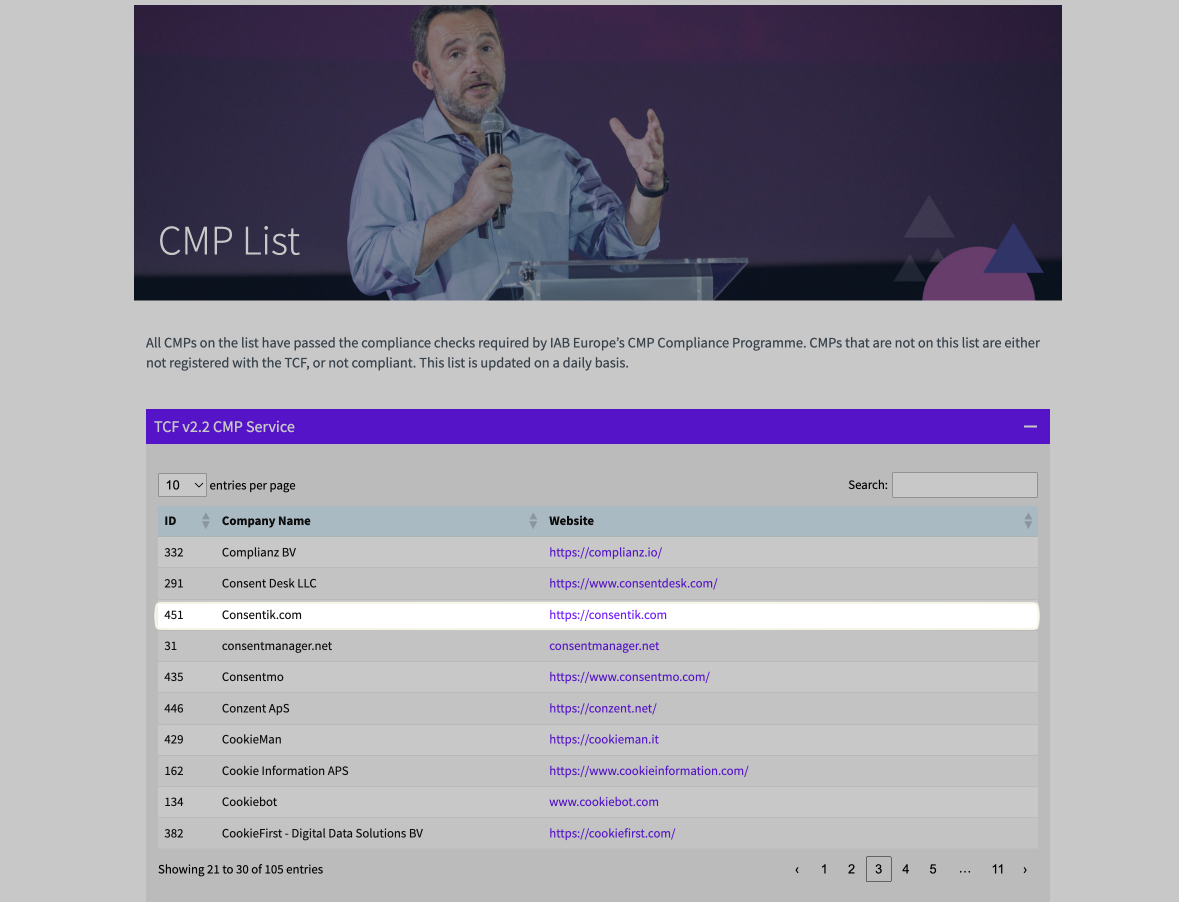
If you’re feeling overwhelmed by evolving IAB TCF deadlines, Consentik takes the complexity out of privacy compliance. As an approved CMP under the IAB Transparency and Consent Framework, Consentik meets IAB Europe standards to manage user consent in line with privacy laws like GDPR.
So, what makes Consentik a game-changer? Let’s break it down:
- Ensure businesses meet GDPR requirements by collecting and storing user consent data accurately. It makes the consent process transparent and straightforward.
- Allow users to provide specific consent for different data processing activities, such as personalized ads or analytics. This ensures businesses respect user preferences.
- Offer a user-friendly interface, making it easy for businesses to set up and customize consent forms and banners for websites and apps.
- Provide detailed logs of user consent, which are essential for audits and proving compliance during inspections.
- Consentik supports other global privacy laws, making it a great choice for businesses with international operations.
- Automatically update to reflect changes in privacy laws, ensuring businesses stay compliant without extra effort.
Finally, Consentik stands out by taking the complexity out of privacy compliance, making it remarkably straightforward to meet both GDPR and IAB TCF requirements. Every business has unique needs, which is why Consentik offers flexible consent options you can adapt to your specific situation. This transparency in handling user consent does more than just tick boxes – it helps build genuine trust with your users. Most importantly, by ensuring you stay compliant with current privacy regulations, Consentik protects your business from the substantial fines and penalties that come with privacy violations.
Want to dive deeper? Check out the official IAB Europe CMP List to see Consentik in action. It’s not just a compliance tool – it’s your partner in building a more transparent digital world.
Conclusion
The privacy landscape keeps shifting, and smart businesses get ahead by embracing frameworks like IAB TCF 2.2 and its automatic v2.4 updates rather than playing catch-up later. With improved consent tools, better vendor controls, and enhanced reporting features, staying current with TCF isn’t just a legal checkmark – it’s an opportunity to build long-term trust with your users while protecting your ad revenue.