
![2026 Latest Data Privacy Violations [With Real Cases]](https://consentik.com/wp-content/uploads/2025/12/Data-Privacy-Violations-1024x645.png)
Data privacy laws have transformed how websites handle personal information globally. Beyond GDPR‘s €20 million fines, regulations like California’s CCPA, Brazil’s LGPD, and others carry serious penalties. If you collect visitor data through cookies, forms, or analytics, you must follow specific rules to protect user privacy.
This guide explains how to make your site privacy compliant using simple, step-by-step instructions. We’ll also compare the best plugins to help automate the process and keep you compliant.
Data Privacy Fine You Must Know
Data privacy isn’t just about ticking a box – it’s a serious legal and ethical obligation with global implications. While the General Data Protection Regulation (GDPR) is the most recognized, it’s only one part of a growing network of privacy regulations worldwide. From California’s CCPA and CPRA, to Brazil’s LGPD, Japan’s APPI, South Korea’s PIPA, and Thailand’s PDPA, dozens of regions have passed laws to protect users’ personal data – and they all come with consequences for non-compliance.
The Risks Are Real
- GDPR: Fines can reach up to €20 million or 4% of your company’s global annual revenue, whichever is higher.
- CCPA/CPRA (California): Penalties up to $7,500 per intentional violation. Class action lawsuits are also possible in the event of a breach.
- LGPD (Brazil): Up to 2% of a company’s Brazilian revenue, capped at 50 million BRL (approx. $10 million).
- APPI (Japan): Enforced by the Personal Information Protection Commission, with growing global enforcement partnerships.
- PIPA (South Korea) and PDPA (Thailand): Carry both administrative and even criminal penalties for misuse or unauthorized transfer of personal data.
Violations don’t just lead to legal fees – they damage your brand and break user trust. In an era where consumers are more aware of their rights than ever, that can be a dealbreaker. According to industry surveys, 80% of users stop engaging with brands that misuse their data or fail to offer transparency around consent.
The flip side? Businesses that are transparent and proactive about data protection build more loyal relationships. Users are more likely to share data when they feel it’s being handled respectfully. Compliance doesn’t just shield you from fines – it becomes a competitive edge.
Being upfront with cookie usage, consent options, and privacy policies shows users that you respect their rights – and that pays off in long-term trust and brand value.
Recent GDPR Violations and What They Teach Us
Learning from recent data privacy violations helps you avoid these costly mistakes. Here are recent high-profile violations and the lessons they offer for site owners:
SHEIN: €150 Million Fine for Cookie Violations

What happened: This massive data privacy fine of €150 million shows regulators are serious about enforcement for serious cookie consent violations affecting 12 million monthly French visitors.
Regulator: CNIL (France) | Year: 2023
Laws Violated:
- ePrivacy Directive (Article 5(3)) – Consent must be obtained before placing non-essential cookies.
- GDPR Article 7 – Consent must be freely given, specific, informed, and unambiguous.
- GDPR Article 13 – Obligation to inform users about data processing and third parties.
Key Issues:
- Placed advertising cookies before consent.
- Incomplete cookie banners lacking purpose disclosure.
- Did not disclose third parties placing cookies.
- “Reject” button failed to stop cookie placement.
- Ignored warnings since 2020.
Lesson: Having a cookie banner isn’t enough. Your banner must actually block non-essential cookies until consent is given, provide complete information about cookie purposes, and ensure “reject” choices work properly.
Orange: €50 Million for Marketing and Cookie Issues

What happened: CNIL fined Orange €50 million for displaying ads in email inboxes without consent and continuing to read cookies after users withdrew consent.
Regulator: CNIL (France) | Year: 2023
Laws Violated:
- ePrivacy Directive (Article 5(3)) – Consent required before reading/writing cookies.
- GDPR Article 6(1)(a) – Lack of valid legal basis for direct marketing.
- GDPR Article 7(3) – Consent withdrawal must be as easy as giving consent.
Key Issues:
- Showed ads in email inboxes without proper consent.
- Continued reading cookies after withdrawal.
- Failed to implement technical measures to honor withdrawal.
Lesson: If you embed promotional content in areas users expect to be personal (like dashboards or member areas), you need explicit consent. Cookie consent withdrawal must actually stop tracking – test this regularly.
RTL Belgium: Deceptive Cookie Banner Design

What happened: Belgium’s data protection authority ordered RTL Belgium to fix their cookie banner design that steered users toward accepting cookies.
Regulator: APD (Belgium) | Year: 2023
Laws Violated:
- GDPR Article 5(1)(a) – Transparency and fairness in data processing.
- GDPR Article 7 – Freely given consent must not be manipulated.
- ePrivacy Directive – Consent UX must not nudge or deceive.
Key Issues:
- No “Reject All” on the first screen.
- Used color to bias acceptance.
- Made withdrawing consent harder.
- Used dark patterns to steer consent.
Lesson: Cookie banners must offer equal choices. If you have “Accept All,” you need “Reject All” with equal prominence. Avoid design tricks that push users toward acceptance.
UNIQLO: €270,000 for Data Security Breach

What happened: Spain’s data protection authority fined UNIQLO €270,000 for accidentally emailing payroll information for 447 workers to a former employee.
Regulator: AEPD (Spain) | Year: 2024
Laws Violated:
- GDPR Article 5(1)(f) – Integrity and confidentiality of personal data.
- GDPR Article 32 – Failure to implement appropriate security measures.
- GDPR Article 33 – Failure to notify about a breach in due time.
Key Issues:
- Sent payroll info of 447 employees to the wrong recipient.
- No access control or email security.
- Lacked internal checks for sensitive data transmission.
Lesson: Security isn’t just about hackers – it’s about preventing accidental data exposure. Implement proper access controls, encrypt sensitive data, and regularly audit who has access to what information.
Healthline Media: $1.55 Million US Settlement

What happened: California’s Attorney General settled with Healthline for $1.55 million over alleged violations of California’s privacy laws.
Regulator: California Attorney General | Year: 2024
Laws Violated:
- CCPA Section 1798.120 – Selling data without notice or opt-out.
- Section 1798.135 – Failure to implement “Do Not Sell” mechanisms.
- Deceptive Practices (California Unfair Competition Law) – Misleading opt-out interface.
Key Issues:
- Continued ad sharing after opt-out.
- Used health-related reading habits for ad targeting.
- Cookie opt-outs didn’t function across services.
- No proper contracts with ad partners.
Lesson: Opt-out choices must actually work across your entire site and with all partners. Be careful about inferring sensitive information from user behavior, and ensure you have proper agreements with third-party services.
Meta (Facebook) – €1.2 Billion GDPR Fine (2023, EU)

What happened: Meta received a record €1.2 billion fine for continuing to transfer EU users’ personal data to US servers after an EU court struck down the previous EU-US data-sharing agreement. Ireland’s Data Protection Commission also ordered Meta to suspend these transfers and delete previously transferred data.
Key violations:
- Transferred personal data without valid legal basis
- Failed to implement proper safeguards for cross-border data transfers
- Violated GDPR Article 46 on transfer mechanisms
Lesson: If your site serves EU users, ensure any personal data transferred outside Europe uses approved safeguards or EU-based hosting. Even small sites must comply with GDPR transfer rules to avoid serious penalties.
Google & Meta – €150M/€60M Cookie Consent Fines (2022, France)

What happened: France’s CNIL fined Google €150 million and Meta €60 million for using “dark pattern” cookie banners that made accepting cookies easy with one click while hiding or complicating the “reject all” option.
Regulator: DPC (Ireland) | Year: 2023
Laws Violated:
- GDPR Article 46 – Cross-border transfers require safeguards.
- GDPR Article 5(1)(a) – Lawful and transparent processing.
- GDPR Article 44 – Transfers must ensure equivalent protection.
Key Issues:
- Continued EU-US transfers after “Schrems II” invalidated prior agreement.
- Failed to implement new transfer mechanisms.
- Ignored earlier compliance orders.
Lesson: Ensure your cookie consent banner offers equal prominence for “Accept” and “Decline” options. Don’t use design tricks that nudge users toward accepting tracking – regulators are actively cracking down on manipulative UX.
Instagram (Meta) – €405 Million GDPR Fine (2022, EU)

What happened: Instagram was fined for mishandling children’s data by allowing 13-17-year-olds to switch to business accounts that publicly displayed their contact information, and setting child accounts to “public” by default.
Regulator: DPC (Ireland) | Year: 2022
Laws Violated:
- GDPR Article 6(1)(a)/(f) – No valid legal basis for publicizing contact info.
- Article 5(1)(c) – Excessive data exposure (data minimization breach).
- Article 25 – No privacy by design/default.
Key Issues:
- Allowed teens’ phone numbers/email to be public.
- Defaulted minor accounts to public visibility.
- No meaningful parental control or warnings.
Lesson: If minors might use your site, implement privacy by default. Keep user profiles private by default for teens, never expose personal information without explicit consent, and review plugin settings to ensure you’re not inadvertently exposing user data.
Sephora – $1.2 Million CCPA Settlement (2022, California)

What happened: Sephora settled with California’s Attorney General for sharing consumer data with third-party advertisers without proper disclosure and failing to honor opt-out requests sent via Global Privacy Control signals.
Regulator: California DOJ | Year: 2022
Laws Violated:
- CCPA §1798.100(b) – Failure to disclose selling of personal data.
- CCPA §1798.135(a)(1) – Omission of “Do Not Sell My Info” link.
- GPC Noncompliance – Ignored global opt-out signals.
Key Issues:
- Used trackers for ads = “sale” under CCPA.
- Failed to implement user opt-out properly.
- Did not update privacy notices.
Lesson: If you use third-party advertising or analytics, understand what constitutes a “sale” under CCPA. Provide clear “Do Not Sell” links where required and configure your plugins to respect user opt-out choices.
Epic Games (Fortnite) – $275 Million COPPA Fine (2022, USA)

What happened: Epic Games paid $520 million total, including a record $275 million COPPA fine for collecting children’s personal information without parental consent and enabling risky chat features by default, plus $245 million for dark patterns leading to unintended purchases.
Regulator: FTC (USA) | Year: 2022
Laws Violated:
- COPPA Rule (16 CFR Part 312) – Collected children’s data without parental consent.
- FTC Act §5 – Unfair/deceptive practices via UI design (dark patterns).
Key Issues:
- Enabled chat features for children without consent.
- Retained kids’ data without proper safeguards.
- Trick-based UI led to unintended purchases.
Lesson: If your site attracts children, comply with COPPA by requiring parental consent for under-13 users. Avoid dark patterns in your design – don’t trick users into sharing data or making purchases through confusing layouts or misleading buttons.
Amazon’s Alexa – $25 Million COPPA Penalty (2023, USA)

What happened: Amazon settled for keeping children’s voice recordings indefinitely and ignoring parents’ deletion requests, despite marketing Alexa as privacy-protective. The company retained kids’ voice and location data for algorithm improvement.
Regulator: FTC (USA) | Year: 2023
Laws Violated:
- COPPA Rule §312.10 – Failure to delete children’s data upon request.
- FTC Act §5 – Misleading parents about data retention.
Key Issues:
- Retained kids’ voice recordings indefinitely.
- Used child data for AI training after deletion requests.
- Marketed Alexa as “privacy-respecting” while doing the opposite.
Lesson: Honor data deletion requests completely – deletion must mean deletion. If you offer users or parents ways to delete personal data, implement it fully. Be transparent about data retention practices and don’t claim privacy protection while doing the opposite.
Amazon’s Ring – $5.8 Million Privacy & Security Fine (2023, USA)

What happened: Ring faced FTC action for allowing unlimited employee access to customer video feeds without safeguards, leading to inappropriate viewing and external hacks where attackers harassed users through compromised cameras.
Regulator: FTC (USA) | Year: 2023
Laws Violated:
- FTC Act §5 – Deceptive data security practices.
- Failure to secure sensitive video content.
Key Issues:
- Internal staff watched user camera footage.
- Hackers accessed live streams via reused passwords.
- No audit logs or MFA required for staff.
Lesson: Implement strict access controls and security measures. Use least privilege principles, maintain audit logs, and employ strong authentication. For WordPress sites, use reputable security plugins, enforce strong passwords/2FA, and promptly patch vulnerabilities.
GoodRx – $1.5 Million Health Data Sharing Fine (2023, USA)

What happened: GoodRx was penalized for sharing users’ prescription and health information with Facebook, Google, and other advertisers without consent, despite privacy policy promises that health data wouldn’t be shared.
Regulator: FTC (USA) | Year: 2023
Laws Violated:
- FTC Health Breach Notification Rule (16 CFR Part 318) – Did not disclose health data sharing breaches.
- FTC Act §5 – Misled users in privacy policy.
Key Issues:
- Shared sensitive health info with Facebook, Google.
- Privacy policy said it didn’t.
- Failed to notify users after unauthorized sharing.
Lesson: Handle sensitive information with extreme care. Audit your third-party integrations (analytics, pixels, etc.) to ensure you’re not inadvertently sharing personal data. Be specific in privacy policies about data use and follow through on promises.
Key Takeaways From These Case Studies
These violations show common patterns that owners should avoid:
- Cookie consent failures are expensive: Multiple fines involved broken cookie systems. Your cookie plugin must actually block scripts until consent is given.
- Design matters legally: How you present choices affects compliance. Equal prominence for accept/reject options isn’t just good UX – it’s a legal requirement.
- Security gaps have consequences: Accidental data exposure can be just as costly as intentional misuse.
- Opt-outs must work everywhere: If users say no to tracking, that choice must be honored across your entire site and with all third-party services.
- Regular testing is essential: Many violations involved systems that didn’t work as intended. Test your consent mechanisms regularly.
Reduce Data Privacy Violations with Consentik
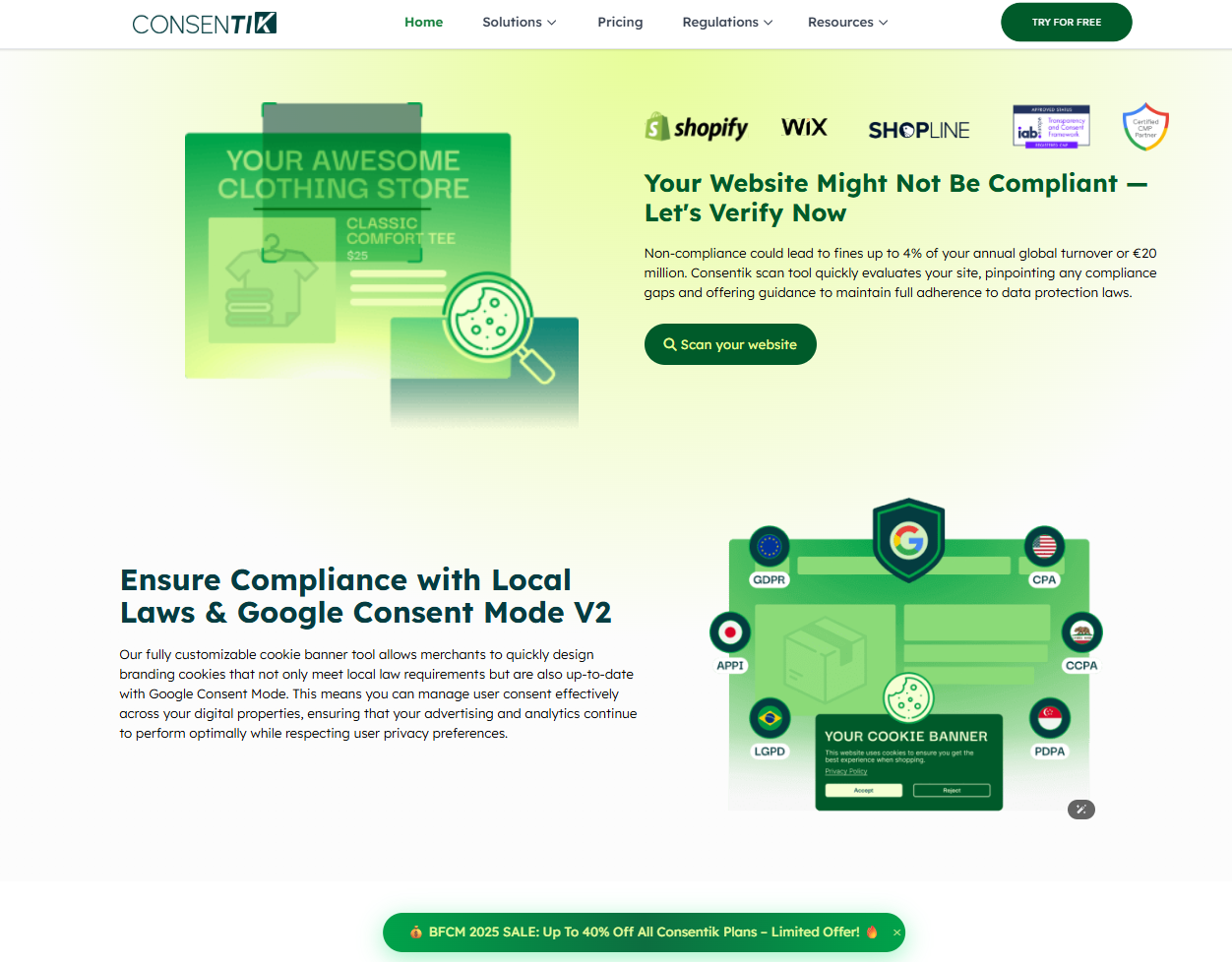
Recent data privacy violation cases show businesses are paying millions in GDPR fines – and your sites aren’t immune. Basic cookie banners don’t actually block scripts. They show pretty notices but still collect data illegally in the background. That’s not compliance – that’s false security that could cost you everything.
Consentik stands out as a Google CMP Partner and a Google-certified consent management platform that handles global privacy laws (GDPR, CCPA, LGPD, and more) with just one setup. What makes it special? It’s free to start and incredibly powerful.
What you get:
- Fully customizable cookie banners that match your brand
- Automatic cookie scanning and blocking until consent is given
- Google Consent Mode v2 integration for better analytics
- Multi-language support with geo-targeting
- Real-time consent logs and detailed analytics
- Special e-commerce features like checkout blocking
Don’t gamble with your business. Get real protection with Consentik CMP and sleep better knowing you’re truly compliant, not just pretending to be.
Data Privacy Violations FAQs
How much can I be fined for GDPR violations?
GDPR fines can reach up to €20 million or 4% of your global annual revenue, whichever is higher. For less severe violations, fines can be up to €10 million or 2% of annual revenue.
The exact amount depends on factors like:
- Severity and nature of the violation
- Whether it was intentional or accidental
- How much data was affected
- Your response to the incident
- Previous violations
For small sites: While €20 million sounds scary, fines are typically proportional to your business size and revenue. However, even smaller penalties can be devastating for small businesses.
What’s the largest GDPR fine ever imposed?
Among the biggest GDPR fines, €1.2 billion imposed on Meta (Facebook) by Ireland’s Data Protection Authority for violating cross-border data transfer rules stands out. This shows that even tech giants aren’t immune to GDPR enforcement.
Do I need GDPR compliance if I’m not in the EU?
Yes, if your site has EU visitors, GDPR applies to you regardless of where you’re located. The law has global reach – any website accessible to EU residents must comply with GDPR requirements.
What counts as personal data under GDPR?
Personal data includes any information that can identify a person, such as:
- Names and email addresses
- IP addresses and cookies
- Photos and videos of people
- Location data
- Online identifiers and usernames
- Even behavioral data that could identify someone
This means contact form submissions, comment data, analytics cookies, and user accounts all contain personal data requiring GDPR protection.
How long do I have to respond to data requests?
GDPR gives you 30 days to respond to user requests for data access, correction, or deletion. This timeline starts when you receive the request, not when you decide it’s valid.
Can I use pre-checked consent boxes?
No, GDPR requires “freely given, specific, informed and unambiguous” consent. Pre-checked boxes don’t meet this standard because users must actively choose to give consent.
Always require users to actively check consent boxes – never have them pre-selected.
What happens if I have a data breach?
Under GDPR, you must:
- Report the breach to authorities within 72 hours if it poses risks to individuals
- Notify affected users “without undue delay” if the risk is high
- Document the breach and your response
You should have an incident response plan, maintain current contact information for authorities, and ensure you can quickly assess the scope of any breach.
Do I need a Data Protection Officer (DPO)?
Most small sites don’t need a formal DPO, but you should designate someone to handle privacy matters. You need a DPO if you:
- Are a public authority
- Engage in large-scale systematic monitoring
- Process large amounts of sensitive personal data
How often should I update my privacy policy?
Update your privacy policy whenever you:
- Add new plugins or third-party services
- Change how you collect or use data
- Modify your cookie setup
- Receive guidance that affects your practices
Best practice: Review your privacy policy at least quarterly and after any significant site changes.
Are there other privacy laws I should know about?
Yes, privacy regulations are expanding globally:
- CCPA/CPRA in California
- LGPD in Brazil
- PIPEDA in Canada
- PDPA in Singapore and other countries
Many privacy plugins now support multiple regulations, making multi-jurisdiction compliance easier.
The Bottom Line
Learning from data privacy violations helps you avoid becoming the next cautionary tale. Whether it’s GDPR’s €20 million fines or CCPA penalties, the risks are real. But so are the solutions. Start with the essentials, choose the right tools, and build user trust through genuine privacy protection.
Take action now. Your site can be both powerful and privacy-conscious – that’s not just good legal practice, it’s smart business.



![2026 Latest Data Privacy Violations [With Real Cases]](https://consentik.com/wp-content/themes/consentik-theme/assets/logos/google-cmp.svg)
![2026 Latest Data Privacy Violations [With Real Cases]](https://consentik.com/wp-content/themes/consentik-theme/assets/logos/iab-tcf.svg)
![2026 Latest Data Privacy Violations [With Real Cases]](https://consentik.com/wp-content/themes/consentik-theme/assets/logos/shopify-partner.png)
![2026 Latest Data Privacy Violations [With Real Cases]](https://consentik.com/wp-content/themes/consentik-theme/assets/logos/wix-white.png)
![2026 Latest Data Privacy Violations [With Real Cases]](https://consentik.com/wp-content/themes/consentik-theme/assets/logos/shopline-white.png)
![2026 Latest Data Privacy Violations [With Real Cases]](https://consentik.com/wp-content/themes/consentik-theme/assets/logos/wp.png)
![2026 Latest Data Privacy Violations [With Real Cases]](https://consentik.com/wp-content/themes/consentik-theme/assets/logos/ms.png)
![2026 Latest Data Privacy Violations [With Real Cases]](https://consentik.com/wp-content/themes/consentik-theme/assets/logos/consentik-light.png)